Knowing how to remove granite countertops is a skill most homeowners can master without calling a contractor. Yes, the stone is heavy and the adhesive bonds are strong — but once you understand what holds the slab in place, the process becomes methodical, not mysterious. Whether you're tackling a full kitchen remodel, replacing a cracked slab, or repairing water-damaged cabinets underneath, the five methods in this guide give you a clear path forward. Browse more projects like this in our home improvement section.
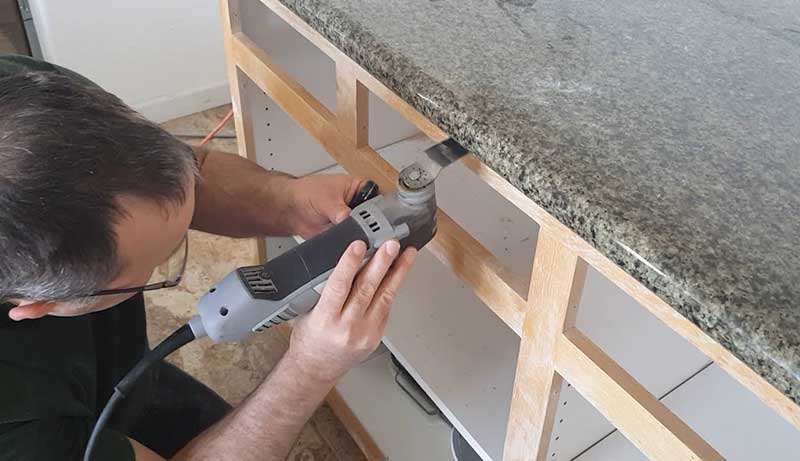
Granite slabs are held in place by silicone caulk (a flexible, waterproof sealant) along the backsplash and front edges, plus a thin layer of construction adhesive resting on top of the cabinet frames. Some installers add mechanical clips near sink cutouts. The sheer weight of the stone — up to 20 pounds per square foot — keeps most slabs firmly seated even without a lot of adhesive. Your goal is to cut through those bonds cleanly, then lift with enough hands to do it safely.
Before you pick up a tool, do the math on your slab. A standard kitchen countertop of 25 square feet can weigh between 375 and 500 pounds. Get at least one helper — two is better for anything longer than a small bathroom vanity. Shut off the water supply, disconnect the plumbing under the sink, and clear everything out of the cabinets below. Good prep makes the actual removal faster and, more importantly, safer.
Contents
Before you can successfully remove granite countertops, you need to know exactly what's holding them down. According to Wikipedia, granite is one of the hardest and densest natural stones used in construction — which means it won't cooperate unless you address every bond point in the right order.
Installers typically rely on three bonding methods:
The age of the installation also matters. Caulk and adhesive cure harder over many years, so an older kitchen may put up more resistance than a recent install. Slabs set over a plywood substrate (a rigid backing board glued to the cabinet frames) bond more aggressively than those resting directly on open frames. Take a look under your cabinets before you start — knowing what you're dealing with shapes your entire approach.
Gather everything before you begin so you're not scrambling mid-removal:
Don't skip the suction cups. You're handling a slab that could weigh 400 pounds or more — smooth stone surfaces give your fingers nothing to grip. Suction cup lifters are inexpensive to rent and make the difference between a controlled lift and a dropped slab.
You'll want to know how to remove granite countertops in several common home improvement scenarios:
Once the slab is off, you'll likely face adhesive residue on the cabinet frame tops. Removing it cleanly without gouging the wood takes the right scraper blade. Check out our guide to the best cabinet scrapers — the right tool leaves a flat, smooth surface ready for your next install.
Sometimes removal isn't a choice — it's the only option:
In damage-driven removals, slow down even more than usual. Weakened cabinet frames crumble more easily under lateral force. Check the wood condition as you pry, and be ready to adjust your technique if the structure is compromised.
Not every removal job calls for the same approach. Here's how the five main methods compare so you can pick the right one for your situation:
| Method | Best For | Skill Level | Key Tools | Damage Risk |
|---|---|---|---|---|
| Utility knife + pry bar | Most standard kitchen and bath installs | Beginner | Knife, pry bar, suction cups | Low |
| Oscillating multi-tool | Thick or heavily cured caulk and adhesive | Beginner–Intermediate | Oscillating tool, bi-metal blade, pry bar | Low |
| Heat gun softening | Stubborn construction adhesive bonds | Intermediate | Heat gun, knife, pry bar | Low–Medium |
| Reciprocating saw | Sink cutouts with multiple clips or brackets | Intermediate | Reciprocating saw, suction cups | Medium |
| Professional removal | Large, complex, or single-piece slabs | N/A (hire out) | Professional lifting equipment | Very Low |
This approach works for most standard kitchen and bathroom slabs. It's the safest method for preserving both the granite and the cabinets underneath.
When you're ready to reseal after your new surface goes in, product choice matters more than most people think. Our review of the best removable caulk covers flexible options that hold up to daily kitchen use but release cleanly if you ever need to repeat this process.
Strong adhesive bonds are the most common obstacle when you're trying to remove granite countertops. Work through them systematically:
Never use a crowbar with heavy leverage against the edge of a granite slab. You'll crack the stone before you free it. Slow, even pressure distributed across the full length always wins over one hard push at a single spot.
Granite cracks when force is uneven. Follow these rules every time:
Once your cabinets are exposed and the residue is cleaned up, you have more options than just reinstalling stone. If you're exploring alternatives, our guide to the best epoxy for countertops covers overlay systems that bond directly to existing cabinet frames — no heavy slab required.
Removing granite countertops yourself saves real money. Professional removal typically runs $200 to $600 depending on slab size and job complexity. Beyond the cost, DIY gives you real advantages:
For a single bathroom vanity, a small galley kitchen strip, or any run under six feet, DIY is well within reach for anyone comfortable with basic hand tools and a willing helper.
DIY isn't always the right call. Bring in a professional when:
Professionals carry liability insurance. If something goes wrong with a 400-pound slab — a cracked stone, a damaged floor, an injured helper — that coverage matters. For a full kitchen with an island, the cost of professional removal is cheap compared to replacing a cracked countertop or a destroyed run of custom cabinetry.
The difference between a cracked slab and a clean removal comes down to one thing: every inch of caulk you skip on the score is a risk you're taking with hundreds of pounds of stone.


About Mike Constanza
For years, Mike had always told everyone "no other sport like baseball." True to his word, he keeps diligently collecting baseball-related stuff: cards, hats, jerseys, photos, signatures, hangers, shorts (you name it); especially anything related to the legendary player Jim Bouton.Mike honorably received Bachelor of Science degree in Business Administration from University of Phoenix. In his graduation speech, he went on and on about baseball... until his best friend, James, signaled him to shut it.He then worked for a domain registrar in Phoenix, AZ; speciallizng in auction services. One day at work, he saw the site JimBouton.com pop on the for-sale list. Mike held his breath until decided to blow all of his savings for it.Here we are; the site is where Mike expresses passion to the world. And certainly, he would try diversing it to various areas rather than just baseball.
You can get FREE Gifts. Or latest Free phones here.
Disable Ad block to reveal all the info. Once done, hit a button below
 im
im