by Lindsey Carter
A single unsuppressed shot from a .357 Magnum reaches 165 decibels at your ear — loud enough to cause immediate, irreversible damage to your inner ear in milliseconds. If you're weighing earplugs vs. earmuffs for shooting, you're already asking the right question. Both protect your hearing, but each brings different strengths to different situations. Your caliber, your range environment, and the fit you can achieve with each option all determine which one belongs in your kit. Whether you're browsing through our sports and outdoors section as a new shooter or you've been a regular at the range for years, this guide helps you make a confident, well-informed choice.
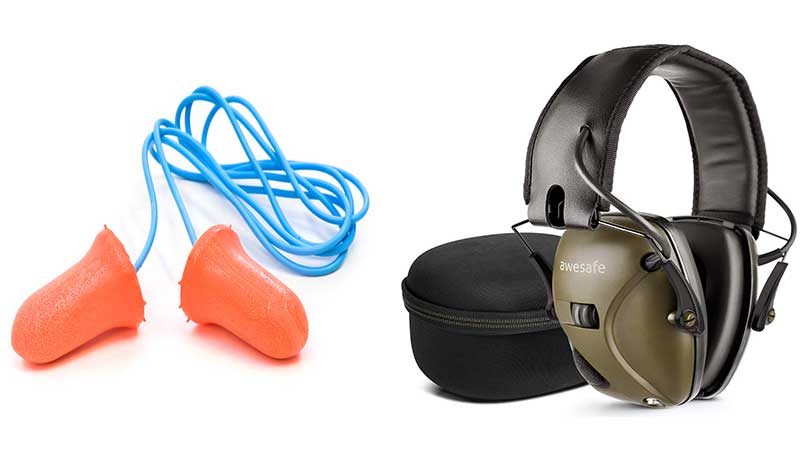
The science behind hearing damage is unambiguous. Noise-induced hearing loss is permanent. The sensory hair cells in your cochlea that translate sound into neural signals do not regenerate once they're gone. That ringing in your ears after a range session isn't just an inconvenience — it's a warning that your protection failed, or wasn't worn at all. Getting the earplugs vs. earmuffs decision right means understanding more than NRR numbers on a package. It means knowing how each option performs under the specific conditions you actually shoot in.
This guide walks you through how each type works, when each holds the advantage, what mistakes leave shooters unprotected, and how to build a protection strategy that holds up across years on the range. You'll find a direct comparison table, budget breakdowns at every level, and practical guidance drawn from real shooting scenarios.
Contents
Earplugs work by filling your ear canal and blocking sound before it reaches your eardrum. Foam types expand to form a custom fit each time you insert them; flanged silicone versions use multiple ridges to create a seal without requiring the same technique. Custom-molded earplugs, made by an audiologist from an impression of your canal, take this further — they fit the exact contour of your individual anatomy for the most reliable seal available. The entire device sits inside your ear, completely unaffected by anything happening around your head.
Earmuffs take the opposite approach. Hard cups lined with acoustic foam form a seal around the outside of your ear, reducing sound through a combination of mass and absorption. They require no insertion technique, come off in seconds, and perform consistently regardless of your ear canal shape. Electronic earmuffs add active components that amplify safe ambient sounds while automatically suppressing impulse noise above a set threshold — typically 82–85 dB — letting you hear conversation and range commands without removing your protection.
The Noise Reduction Rating (NRR) is the EPA-standardized measure of how much a protector attenuates sound under laboratory conditions. Foam earplugs reach the regulatory ceiling at NRR 33. Premium passive earmuffs typically top out around NRR 28–31. But real-world performance consistently falls short of labeled ratings. NIOSH recommends halving the NRR to estimate field performance — which means an NRR 33 earplug realistically delivers about 16–17 dB of actual protection under typical insertion conditions. That gap matters when you're shooting calibers that push past 160 dB.
| Protection Type | NRR Range | Ideal Use Case | Key Advantages | Main Limitations |
|---|---|---|---|---|
| Foam Earplugs | 28–33 | High-caliber, indoor range | Highest NRR available, low cost, compact, works with rifle stocks | Technique-dependent; correct insertion is critical |
| Flanged Earplugs | 22–27 | Recreational shooting, hunting | Reusable, easy to insert, low maintenance | Lower NRR than foam; seal consistency varies |
| Passive Earmuffs | 22–31 | General range use, beginners | Consistent seal, no insertion technique needed, fast on/off | Bulky; can interfere with rifle cheekweld |
| Electronic Earmuffs | 22–30 | Range instruction, competitions | Ambient sound amplification with impulse suppression | Higher cost; battery-dependent |
| Custom Molded Plugs | 25–33 | Competitive shooting, daily use | Best anatomical fit, long-term comfort, durable | Requires audiologist fitting; upfront cost |
Earplugs earn their place any time external geometry creates a problem for you. Prone rifle shooting, bench shooting with a high cheekweld, and wearing a tactical helmet all work more cleanly with in-ear protection — earmuff cups press against your rifle stock and can shift your head position just enough to disrupt your sight picture. Earplugs eliminate that interference entirely. They're also the practical default for any situation where weight or pack space matters. A pair of foam plugs weighs almost nothing and disappears into a shirt pocket or vest pouch indefinitely.
For high-caliber shooting — .308 Winchester, .300 Win Mag, 12-gauge — a correctly inserted foam earplug with NRR 33 provides the highest single-device attenuation commercially available. Hunters who need a clean cheekweld in the field benefit from this particularly. If you want a focused breakdown of options calibrated for field use, this guide to best hearing protection for hunting covers the most effective choices tested across real hunting environments.
Earmuffs win wherever fast, repeatable application matters more than maximum attenuation. At a training session where you move on and off the firing line repeatedly, pulling earmuffs over your head takes two seconds and creates a consistent seal every time. There's no reinsertion technique to execute correctly under time pressure. Range officers, instructors, and competitive shooters who communicate frequently find this decisive.
Earmuffs are also the better option for new shooters who haven't yet developed correct earplug insertion habits. A properly worn NRR 25 earmuff provides more real-world protection than a poorly inserted NRR 33 foam plug — every time. And electronic models add genuine value at any experience level: you hear the range officer clearly, hold a conversation at normal volume, and still receive impulse suppression the moment a shot is fired.
Pro tip: If you wear prescription glasses, test your earmuff seal carefully before relying on it — temple arms can break cushion contact and reduce your effective NRR by 5–10 dB.
Most hearing protection failures aren't about product quality — they're about fit. For foam earplugs, the correct technique is to roll the plug into a tight, narrow cylinder, then reach over your head with your opposite hand to pull your ear up and back (which straightens your canal), insert the plug fully, and hold it in place for a full 20–30 seconds while it expands. Releasing too early is the single most common mistake. When you let go, the plug should feel snug and seated — not spring partially out or sit in the outer portion of your canal.
For earmuffs, press the cups firmly against your head and make sure the headband sits directly overhead rather than behind your head. Run your fingers along the cushion edge to check for gaps created by hair, earrings, or a collar. A simple field test works for both types: cup your hands over the protectors after they're in place. If ambient sound drops noticeably when you add that extra layer, your seal is incomplete. Fix the fit, not the product.
Wearing earplugs and earmuffs simultaneously — dual hearing protection — is standard practice at professional indoor ranges and a sensible minimum for large-bore rifle or magnum handgun shooting. The combined protection isn't simply the sum of both NRR numbers. NIOSH estimates you gain roughly 5 dB over the higher-rated single device. That might sound modest, but when your muzzle noise is generating 163–170 dB, those additional decibels keep you meaningfully further from the damage threshold. For high-volume magnum shooting or extended indoor pistol sessions, dual protection isn't overcautious — it's the correct baseline.
Indoor ranges are among the acoustically harshest environments you'll encounter with a firearm in hand. Concrete walls and ceilings reflect muzzle blast back into the shooting bay, building concussive pressure that compounds with every shooter on the line. Noise levels in enclosed bays routinely reach 165–175 dB. If you shoot indoors regularly, your default should be either foam earplugs with NRR 33, dual protection for anything above 9mm, or electronic earmuffs that let you communicate without removing your gear between strings. Electronic models are particularly valuable when you're taking instruction — you can hear corrections and safety calls clearly while staying fully protected throughout the session.
Outdoors, the acoustic environment changes significantly. Sound disperses in open air rather than bouncing off surfaces, and reverb is minimal. A single shot in the field still delivers dangerous noise, but without the layered reflections of an enclosed range bay. Many hunters choose electronic earmuffs precisely for the ambient amplification — being able to hear game movement, leaves, and partner communication while remaining protected from the shot is a genuine tactical and safety advantage.
The honest reality is that hunters skip hearing protection at higher rates than any other shooting population. Part of this is practical — you don't always know when a shot opportunity will present itself. Keeping reusable flanged plugs on a lanyard around your neck removes the "it happened too fast" excuse and builds a habit that protects your hearing across decades of seasons, not just occasional range days.
The most common hearing protection failure isn't choosing the wrong product — it's wearing the right product incorrectly. An earplug inserted only halfway leaves a gap between the foam and your eardrum that dramatically reduces real-world attenuation. Earmuffs worn with the headband behind your head rather than overhead shift the cup angle, compromising the cushion seal on one or both sides. Both are fixable problems, but they require attention. Take five minutes before any new shooting session to check your technique — especially if you're using a product you haven't worn in a while or switching to an unfamiliar style.
Warning: Never use consumer earbuds or standard headphones as a substitute for rated hearing protection — they provide essentially no ballistic impulse attenuation and may actually concentrate certain pressure frequencies at your eardrum.
Not all firearms generate equivalent noise, and your protection should reflect that. A suppressed .22 LR in ideal conditions can approach 140 dB; an unsuppressed .30-06 or 12-gauge routinely exceeds 160 dB. An NRR 22 earmuff that serves you fine during a .22 pistol session is operating near its limits the moment you pick up a larger caliber. The right principle is to protect for your loudest expected firearm, not your average. If you plan to shoot multiple calibers in a single session, set your protection baseline to the most powerful one on your list — not the most common.
You don't need a significant investment to get genuine, rated protection. Bulk disposable foam earplugs — sold in boxes of 100–200 pairs — typically cost $0.15–$0.50 per pair and carry some of the highest NRR ratings commercially available. A $25 box can supply a consistent shooter for an entire year. Passive earmuffs from established brands like Howard Leight or 3M Peltor in the $15–$40 range deliver NRR 22–30 performance with consistent, predictable cushion seals. These are the right starting point if you're new to regular range sessions and haven't yet determined whether earplugs or earmuffs better suit your shooting style.
Electronic earmuffs represent the sharpest performance jump relative to price increase. Entry-level models from Walker's Razor or Caldwell E-Max start around $35–$55, providing passthrough amplification up to 85 dB with automatic impulse suppression above that threshold. Mid-range options from 3M Peltor Sport run $80–$150 and offer faster suppression response times and noticeably better audio fidelity. Professional-grade models — Howard Leight Impact Pro, Peltor Sport Tactical 500 — run $150–$300 and are worth serious consideration if you spend extended time instructing, competing, or operating in any environment where communication and protection must coexist.
Custom-molded earplugs from an audiologist cost $100–$300 for the fitting and fabrication, but last for years and achieve fit precision that no off-the-shelf option matches. Just as you'd invest carefully in a quality ballistic helmet as part of a serious protective loadout, treating your hearing protection as a precision-fitted piece of equipment pays dividends over a lifetime of shooting.
The best hearing protection is the one you actually wear on every range trip, not the highest-rated option sitting in a drawer at home. Reducing friction is the most effective long-term strategy available to you. Keep foam plugs in every range bag, shooting vest pocket, and vehicle glove box. Set a personal rule: no firearm leaves the case until your hearing protection is on. That sounds simple, but the shooters who protect their hearing across decades are the ones who made this automatic rather than situational — applied consistently, not just when they remembered.
Serious shooters treat hearing protection the same way serious athletes treat protective equipment across all disciplines — it belongs in the kit as a non-negotiable, not as an optional add-on. The principle extends across sports categories: just as you'd select specialized equipment for competitive fastpitch based on the specific demands of the game, your hearing protection should be matched to the specific noise environment you're actually shooting in. The right tool for the right conditions is what separates informed participation from unnecessary long-term exposure.
Hearing protection pairs naturally with eye protection as the two items that should never leave your range bag. Once both are treated as mandatory gear rather than optional accessories, the specific choice between earplugs and earmuffs becomes a straightforward optimization — not a debate about whether protection is worth the effort. It always is.
Earplugs insert into your ear canal and block sound before it reaches your eardrum, while earmuffs create an acoustic seal around the outside of your ear. Earplugs typically achieve higher NRR ratings and work better with rifle cheekwelds, while earmuffs offer more consistent protection if you haven't perfected insertion technique and allow faster on/off during range sessions.
Foam earplugs reach the highest commercially available NRR ratings, up to NRR 33. Premium passive earmuffs typically top out around NRR 28–31. However, real-world effectiveness depends heavily on fit — a correctly worn NRR 25 earmuff will outperform a poorly inserted NRR 33 earplug in actual field conditions. Getting the fit right matters more than chasing the highest rating number.
Yes, and for certain applications it's recommended. Dual protection — earplugs worn under earmuffs — adds roughly 5 dB of attenuation above the higher-rated device alone. It's a standard approach for indoor shooting with high-caliber firearms, extended magnum handgun sessions, and any scenario where muzzle noise consistently exceeds 160 dB.
For most range shooters, yes. Electronic earmuffs amplify ambient sound below 82–85 dB — so you can hear normal conversation, range commands, and ambient cues — while automatically suppressing impulse noise above that threshold. If you shoot at public ranges, take instruction, or communicate frequently while shooting, the practical advantage over passive protection is significant and justifies the price difference.
After insertion, your range environment should sound clearly muffled. As a quick test, cup both hands over your ears. If ambient sound drops noticeably when you add your hands, the canal seal is incomplete and the plug needs to be reinserted deeper. A correctly seated foam earplug should feel snug and stay firmly in place when you release it after the full expansion hold.
Yes. Any sound above 140 dB can cause immediate, permanent hearing damage, and most centerfire firearms exceed that threshold without suppression. The cochlear hair cells damaged by acoustic trauma do not regenerate. There is no medically recognized safe threshold for a single unprotected shot from a standard centerfire firearm — the damage can happen in the time it takes to blink.
For general indoor pistol range use, NRR 25–30 is a reasonable minimum. For larger calibers or extended sessions in enclosed bays, NRR 30 or higher from a single device — or dual protection combining a foam earplug with an earmuff — is the more conservative and protective choice. Indoor acoustics amplify muzzle blast significantly compared to outdoor shooting environments.
They can. Earmuff cups press against your rifle stock when you adopt a cheekweld, potentially shifting your head angle and affecting your sight picture. If you're using a scoped rifle or need a tight, consistent cheekweld, earplugs typically solve this problem entirely — since in-ear protection doesn't interact with your stock at all — while maintaining equal or better attenuation.
Your hearing is the one piece of range equipment you cannot replace, upgrade, or buy back — every unprotected shot is a permanent trade you never agreed to make.


About Lindsey Carter
Lindsey and Mike C. grew up in the same neighborhood. They also went to the same Cholla Middle School together. The two famillies from time to time got together for BBQ parties...Lindsey's family relocated to California after middle school. They occasiotnally emailed each other to update what's going on in their lives.She received Software Engineering degree from U.C. San Francisco. While looking for work, she was guided by Mike for an engineering position at the company Mike is working for. Upon passing the job interview, Lindsey was so happy as now she could finally be back to where she'd like to grow old with.Lindset occasionally guest posted for Mike, adding other flavors to the site while helping diverse his over-passion for baseball.
You can get FREE Gifts. Or latest Free phones here.
Disable Ad block to reveal all the info. Once done, hit a button below
 im
im