Ever stood at the edge of a muddy trail with your wheels buried to the axle, wondering if your winch would actually get you out? The Superwinch vs Warn comparison is one of the most debated questions in off-road and automotive accessories circles — and it deserves a straight answer. Both brands have been building recovery winches for decades, both have proven themselves in real field conditions, and both offer a wide range of models across different price points. This guide gives you a hands-on, practical breakdown so you can choose the right winch for your vehicle and your recovery needs.

Superwinch was founded in 1970 and built its early reputation on ATV and UTV recovery winches before expanding into full-size truck territory. Warn, established in 1948, is often credited with pioneering the modern recovery winch and developing locking hub technology that off-roaders still rely on today. According to Wikipedia's overview of winch technology, commercial electric recovery winches trace their roots to mid-20th century industrial and military applications — exactly when Warn was cutting its teeth.
Your decision comes down to specifics: line pull rating, gear type, motor quality, control options, warranty coverage, and price-to-performance ratio. Understanding where each brand excels — and where each falls short — is the difference between a reliable recovery tool and a paperweight bolted to your bumper.
Contents
Understanding where each brand comes from helps you interpret their design choices. Warn built its identity around heavy-duty professional recovery — military contracts, industrial applications, and serious off-road competition shaped their engineering priorities from the start. Superwinch came up through recreational ATV and farm-use markets, which drove them toward accessible price points and user-friendly designs.
Neither heritage is better by default. It means each brand has different assumptions baked into their products — assumptions that may or may not match how you actually use a winch.
| Superwinch LT3000ATV Winch | Warn Vantage 3000 Winch |
|---|---|
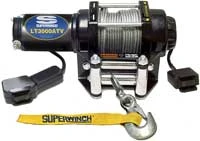 | 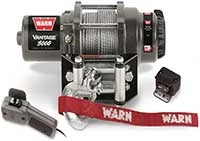 |
Here's how the LT3000ATV and Vantage 3000 stack up on the specs that actually matter in the field. This Superwinch vs Warn comparison shows how similarly rated winches can differ significantly in execution:
| Specification | Superwinch LT3000ATV | Warn Vantage 3000 |
|---|---|---|
| Rated Line Pull | 3,000 lbs | 3,000 lbs |
| Gear Type | Planetary | Planetary |
| Motor Type | 1.3 HP permanent magnet | 1.5 HP series wound |
| Line Speed (no load) | 5.7 ft/min | 3.8 ft/min |
| Wire Rope Diameter × Length | 5/32" × 50 ft | 3/16" × 50 ft |
| IP Rating | IP54 | IP68 (solenoid box) |
| Warranty | 1 year limited | Lifetime (Warn Lifetime Guarantee) |
| Typical Street Price | ~$120–$150 | ~$250–$300 |
The Warn's series-wound motor delivers better sustained performance under heavy load — critical during a long, difficult pull where heat builds fast. Superwinch's permanent magnet motor is simpler, draws less current at idle, and is quicker on light pulls. Neither motor type is universally superior; the right pick depends on how hard and how often you push the winch.
The single most common mistake in any Superwinch vs Warn comparison shopping trip is selecting a winch rated exactly at your vehicle's gross vehicle weight. The standard rule in serious recovery circles is to choose a winch rated at 1.5 times your GVW. Here's why that buffer matters:
Winches are serious electrical loads. A 9,500-lb-rated winch can pull 400–500 amps under full load — far more than your alternator can supply on its own. Your battery takes the entire hit during hard pulls. Understanding how long it takes to recharge a 12V battery becomes directly relevant to recovery planning when you're doing multiple pulls in a session.
Pro tip: Always connect your winch wiring directly to the battery terminals, not to a distribution block or fuse panel. Voltage drop across long runs kills winch performance and can damage the motor over time.
Warn's lifetime warranty and higher price point have created a perception that Superwinch is a "budget brand" that cuts corners. That's an oversimplification. For recreational ATV use, weekend trail riding, or occasional farm recovery, a Superwinch LT3000ATV or Terra series delivers more than adequate performance at a fraction of the cost. You're not compromising safety — you're right-sizing your investment.
Warn earns its premium in high-frequency, high-load scenarios: competition recovery, professional overlanding, emergency services, and vehicles that get seriously stuck on a regular basis. If that describes your use case, the price difference is absolutely justified. If you're pulling a side-by-side out of a creek twice a year, a properly sized Superwinch handles that job reliably.
Mounting bolt patterns, roller fairlead clearances, and bumper receiver compatibility vary significantly across models and vehicle platforms. Physically bolting a winch to your bumper doesn't mean it's properly integrated. Common compatibility traps include:

Always verify fitment against your specific bumper and vehicle model before ordering. Manufacturer fitment guides are a starting point, not a guarantee — call tech support if you're uncertain.
Your winch is one component in a functional recovery system. Whether you're running a Superwinch or a Warn, the accessories around it determine whether a recovery goes smoothly or turns into a multi-hour ordeal. Here's what belongs in your kit:

The planetary gear design inside both brands' mainstream models works on the same principle — planet gears orbiting a sun gear through a ring gear — but manufacturing tolerance and material quality vary meaningfully between budget and premium tiers. Both brands' mid-tier and premium units use helical-cut planetary gears for quieter, more efficient power transfer.
If you run your winch in off-grid or extended overlanding setups, power management becomes a real engineering consideration. Some overlanders integrate solar charging systems to maintain battery capacity during multi-day trips. Understanding PWM vs MPPT solar charge controllers matters here — MPPT controllers are significantly more efficient at maintaining deep-cycle battery health under the kind of cycling that repeated winch use creates. For a deeper look at battery options, this roundup of the best deep-cycle solar batteries covers several options well-suited to dual-battery recovery setups.
Warning: Never run your winch with the engine off for extended pulls. You can drain a full battery in under five minutes at heavy load — leaving yourself stuck with a dead vehicle on top of a stuck vehicle.
Both Superwinch and Warn motors can fail — but how they fail differs. Permanent magnet motors, common in Superwinch's lighter models, are more susceptible to heat-related demagnetization under sustained overload. Series-wound motors, Warn's preference for truck-rated units, handle sustained heat better but are more sensitive to low-voltage conditions. Here are the most common motor symptoms and their likely causes:
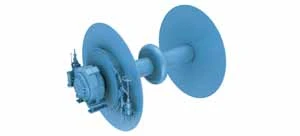
Wire management on the drum is worth paying close attention to. A single layer of rope spooled unevenly creates binding under load. Always spool under tension — drive slowly away from your anchor while taking up rope rather than free-spooling it back loosely.
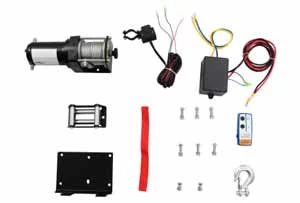
Wired remote controllers are mechanically simple and rarely fail. Wireless remotes add a failure point that catches users off guard. Knowing how to diagnose each type quickly matters in the field:
If you're also working through other electronics diagnostics on your rig, this guide on how radar detectors work provides useful context on how 12V vehicle electronics integrate, draw power, and can interfere with each other — relevant background when you're adding multiple aftermarket accessories.
Who Superwinch is right for: recreational ATV and UTV riders, budget-conscious buyers, light-duty recovery, and first-time winch owners who want a capable unit without overinvesting.
Who Warn is right for: serious off-roaders, overlanders, professional users, and anyone who wants a set-it-and-forget-it winch that will outlast the vehicle it's mounted on.
The Superwinch vs Warn comparison ultimately comes down to use frequency and severity. Both brands build winches that work. Your job is to match the spec to the actual application — not to the most impressive rating you can find.
For light to moderate recreational use — ATV recovery, occasional trail winching, farm applications — Superwinch is reliable and delivers solid value. Warn pulls ahead in high-frequency, high-load scenarios where sustained motor performance and a lifetime warranty justify the premium price. The reliability gap narrows considerably when you're comparing mid-tier models in similar use cases.
Warn's premium truck-rated models carry an IP68 rating on the solenoid housing, meaning the control box is fully submersible — a meaningful advantage for deep water crossings. Superwinch's mainstream models typically carry IP54, which handles splash and rain well but isn't designed for submersion. If your off-road routes include river crossings or regular deep-mud work, Warn's higher IP rating is a real differentiator.
It depends on the winch rating and your vehicle's existing electrical system. For ATV-rated winches drawing under 200 amps, a stock battery is usually adequate for occasional pulls. For truck-rated winches pulling 400+ amps under load, a dedicated deep-cycle battery or dual-battery setup is strongly advisable — especially if you anticipate multiple pulls in a session. Your alternator alone cannot keep up with a working winch under load.


About Lindsey Carter
Lindsey and Mike C. grew up in the same neighborhood. They also went to the same Cholla Middle School together. The two famillies from time to time got together for BBQ parties...Lindsey's family relocated to California after middle school. They occasiotnally emailed each other to update what's going on in their lives.She received Software Engineering degree from U.C. San Francisco. While looking for work, she was guided by Mike for an engineering position at the company Mike is working for. Upon passing the job interview, Lindsey was so happy as now she could finally be back to where she'd like to grow old with.Lindset occasionally guest posted for Mike, adding other flavors to the site while helping diverse his over-passion for baseball.
You can get FREE Gifts. Or latest Free phones here.
Disable Ad block to reveal all the info. Once done, hit a button below
 im
im