You're crouching behind your entertainment center, measuring the available PCIe slot space with a ruler while your spouse asks why you're still not ready to watch the movie. Sound familiar? Picking a video card for an HTPC (Home Theater PC) is one of those decisions that looks simple on the surface but gets complicated fast once you start comparing form factors, power limits, and display output versions. The wrong GPU turns your sleek living room setup into a loud, power-hungry mess.
In 2026, the good news is that the market for compact, low-profile graphics cards is better than ever. From budget-friendly options that handle 4K streaming without a fan spinning up, to mid-range cards that let you sneak in some light gaming between movie nights, there's a card for every HTPC build. If you're shopping in the broader tech and electronics category, GPU choices can feel overwhelming — so we did the work for you.
We evaluated six top-rated cards for HTPC use, focusing on what actually matters in a living room PC: noise levels, power consumption, hardware video decoding (H.265/HEVC, AV1, VP9), display output versions, and physical size. Each card below has a clear use case. Read through the reviews, check the buying guide, and you'll know exactly which one fits your setup.

Contents




If your HTPC budget is tight and your needs are straightforward — 1080p streaming, basic video playback, maybe some light photo or video editing — the ZOTAC GT 1030 gets the job done without drama. This card runs on a 64-bit memory bus with 2GB GDDR5 VRAM (video memory used by the GPU), and it draws so little power that most systems won't even need an extra PCIe power connector. You plug it in, install the GeForce Experience driver, and you're done.
The low-profile bracket is included, which is critical for slim HTPC cases. PCIe 3.0 connectivity means it'll work in virtually any modern motherboard without compatibility headaches. DirectX 12 support means it handles streaming apps and basic Windows 11 tasks without issue. The GeForce Experience software lets you update drivers with a single click — no digging through Nvidia's website manually. For a card this affordable, that's a real convenience win.
Where it falls short: 4K streaming can push this card to its limits depending on the codec (video compression format). AV1 hardware decoding — needed for efficient YouTube 4K and Netflix streams — isn't supported on the Pascal architecture (Nvidia's older chip design used here). If you're watching H.264 or H.265 content at 1080p or 1440p, this card is rock solid. Push it to 4K AV1 and you'll feel the strain. But for budget HTPC builders in 2026, the GT 1030 from ZOTAC remains one of the most reliable entry points on the market.
Pros:
Cons:
The ASUS GT 1030 takes the same Pascal GPU silicon as the ZOTAC above and wraps it in something genuinely special for HTPC use: a passive heatsink. That means zero fans. Zero fan noise. Absolute silence during movie playback, music listening, or light gaming sessions. ASUS achieved this with their exclusive heatsink design — a chunky aluminum fin array that dissipates heat through convection alone. For a living room PC where silence is non-negotiable, this is a major advantage over fan-cooled alternatives.
The boost clock runs at 1506MHz in OC mode, which is a step up from the reference GT 1030 spec and gives you a bit more headroom for smooth video processing. The card is built using ASUS's Auto-Extreme manufacturing process with Super Alloy Power II components — aerospace-grade materials that ASUS uses to improve long-term reliability. That's not marketing fluff: capacitors and chokes built to tighter tolerances genuinely last longer under thermal cycling, which is exactly what happens in an always-on HTPC. The HDMI and DVI outputs cover most TV and monitor connections you'll encounter.
Like the ZOTAC, this card shares the same Pascal architecture limitations — no AV1 decoding, 64-bit memory bus, 2GB VRAM. But if your use case is 1080p media playback in total silence, there is no better-engineered card at this price point. The passive design also means one less point of failure. No fans means no bearings to wear out, no dust buildup on spinning blades, and no sudden noise spikes when the card warms up. Your HTPC stays quiet from day one to year five.
Pros:
Cons:
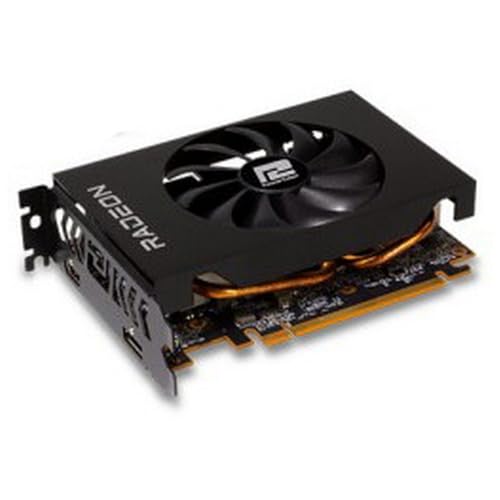
The PowerColor RX 6500 XT ITX is where things get genuinely exciting for HTPC builders who want more than basic video playback. This card packs 1024 stream processors (the parallel computing units that handle graphics workloads), 4GB of fast GDDR6 memory running at 18.0 Gbps, and a game clock of 2610MHz — numbers that put it in a completely different league from the GT 1030 cards above. Maximum digital resolution support goes up to 7680×4320 (8K), which future-proofs your setup well beyond 4K displays.

The ITX (small form factor) design is purpose-built for compact HTPC cases that can't fit a full-length card. AMD's RDNA 2 architecture (the chip design underneath the RX 6500 XT) includes hardware H.265 and VP9 decoding, which covers the majority of streaming video formats you'll encounter on Netflix, Amazon Prime, Disney+, and YouTube. It also handles light gaming beautifully — 1080p gaming at high settings is comfortably within reach, and 1440p works at medium settings. This is the card to pick if your HTPC doubles as a gaming machine.
One thing to note: the RX 6500 XT does not include AV1 decode hardware (that arrived with AMD's RDNA 3 generation). That said, H.265 hardware decoding handles the vast majority of high-quality streaming in 2026. The card runs warm under gaming load but stays cool during video playback. If you're also interested in complementary upgrades for your home theater setup, check out the best LED strip lights on Amazon to complete your entertainment room ambiance.
Pros:
Cons:
The MSI GTX 1650 D6 Ventus XS OC hits a sweet spot that many HTPC builders are looking for in 2026: real gaming capability, manageable power draw, and a compact enough design to work in most living room cases. The 4GB GDDR6 memory at 12 Gbps gives it considerably more bandwidth than the GDDR5 cards in the GT 1030 tier. Boost clock lands at 1620MHz. Maximum resolution goes up to 7680×4320. VR (virtual reality) readiness is officially supported, though most HTPC users won't be running a headset from their couch.

What makes this card stand out for HTPC use is the combination of Nvidia's Turing architecture (which supports H.265, VP9, and partially AV1 decode via NVDEC) and the Ventus XS dual-fan cooler design. Even under gaming load, the fans stay quiet enough for a living room environment — they only spin up noticeably when you're playing demanding titles at 1080p. During video playback, the card barely warms up, meaning the fans often drop to near-silent speeds. DirectX 12 and HDCP (content protection needed for streaming encrypted video) are both fully supported.
If you're coming from an older system built around a processor like the best AMD FX processor generation, pairing one of those rigs with the GTX 1650 is one of the most cost-effective HTPC upgrades available. The card handles everything from 4K HDR video playback to 1080p gaming at high/ultra settings. HDMI output ensures direct plug-in to your TV with audio passthrough (the signal path that sends sound through the GPU's HDMI port to your TV or AV receiver).
Pros:
Cons:
If you're building a premium HTPC in 2026 and you want the best possible video decode capabilities in a low-profile package, the Gigabyte RTX 3050 OC Low Profile 6G is the answer. This card is built on Nvidia's Ampere architecture — the same generation that introduced hardware AV1 decode acceleration. That matters enormously right now. AV1 is the codec (video compression format) that YouTube, Netflix, and most major streaming platforms are moving toward for 4K HDR content because it delivers better quality at lower bitrates (data rates). Hardware AV1 decoding means your GPU handles this efficiently rather than leaning on your CPU.
The specs back up the premium positioning: 6GB GDDR6 memory, PCI-E 4.0 interface (the fastest PCIe standard in current mainstream systems), 1477MHz core clock, and dual DisplayPort 1.4 plus dual HDMI 2.1 outputs. HDMI 2.1 is the standard that enables 4K at 120Hz, 8K at 30Hz, and Variable Refresh Rate (VRR — technology that syncs the display's refresh rate to the GPU's output to eliminate screen tearing). If you have a high-refresh 4K TV and want to use it properly, HDMI 2.1 is non-negotiable, and this is one of the few low-profile cards that delivers it.
The Ampere architecture also includes second-generation RT Cores (for ray tracing — a lighting technique that simulates realistic light reflection) and third-generation Tensor Cores (for AI-powered features like DLSS, which upscales lower-resolution images using AI). For HTPC gaming, DLSS lets you run games at 1440p while outputting near-4K quality. For a card that fits in a slim low-profile case with a low-profile bracket included, this is an impressive technical achievement. The price premium over the GTX 1650 is justified by the generational leap in codec support and display output quality. If you're also looking at managing your GPU's position in your case, a quality vertical GPU mount can improve airflow in larger HTPC builds.
Pros:
Cons:
The Sparkle Intel Arc A310 ECO is a card that challenges conventional thinking about low-power GPUs. Intel's Arc A310 chip supports hardware AV1 decode — a feature not found in the much older GT 1030 or even the GTX 1650. At just 50W TBP (total board power — the maximum power the entire card draws from the system), it runs remarkably efficient while delivering 4GB of GDDR6 memory at 15.5 Gbps across a 64-bit bus. The ECO designation signals Intel's focus on power efficiency, and it shows in real-world HTPC use.

The physical design is a marvel of compact engineering. This is a single-slot, single-fan card with a short bracket included alongside the standard low-profile bracket. It outputs via one HDMI 2.0 port and two mini-DisplayPort connectors — a slightly unusual combination that works well if your TV or monitor supports DisplayPort input or if you have a mini-DP to HDMI adapter. The HDMI 2.0 output supports 4K at 60Hz, which covers the vast majority of home theater scenarios in 2026. For reference on what a proper home theater PC setup entails, Intel's Arc architecture aligns well with modern HTPC requirements.
Intel's driver maturity has improved significantly since the Arc A-series launch, and in 2026 the A310 is a stable, reliable choice for media-focused systems. Gaming performance is modest — think 1080p at low-to-medium settings for older titles and esports games. But for an HTPC where streaming, video playback, and low power bills are the priority, this card earns its place. The single-slot design is a genuine advantage in cases where adjacent PCIe slots are needed for other cards or expansion.
Pros:
Cons:
Before comparing specs, be honest about your use case. Are you building a dedicated 4K streaming box that stays on for hours? A gaming PC disguised as a living room device? A media server that also handles photo editing? Each scenario points to a different card.
For pure streaming and video playback, AV1 hardware decode is the most important feature in 2026. Without it, your CPU handles AV1 decoding in software — which drains performance, increases power consumption, and generates more heat. Cards with AV1 hardware decode: the RTX 3050, the Arc A310. Cards without: the GT 1030 (both versions), the GTX 1650, and the RX 6500 XT. If Netflix and YouTube 4K are your main workloads, prioritize AV1 support above all else.
For HTPC gaming, prioritize memory bandwidth and GPU compute power. The RX 6500 XT and GTX 1650 both offer genuine 1080p gaming capability. The RTX 3050 adds DLSS for near-4K quality in supported titles.
HTPC cases come in a range of sizes, and GPU physical dimensions determine compatibility before you even look at performance. Low-profile cards (also called half-height cards) are roughly half the height of standard cards and fit in slim desktop cases and ITX (small form factor) enclosures. All six cards on this list are low-profile compatible, but verify that your case's slot length also accommodates the card's PCB length.
Single-slot cards like the Arc A310 preserve adjacent expansion slots. Dual-slot cards like the ASUS GT 1030 and RTX 3050 occupy the slot below the PCIe slot as well. In most HTPC builds this isn't an issue, but in tight mini-ITX cases with limited airflow, every centimeter matters. Always measure your available space before ordering.
Your GPU's output ports must match what your TV or display supports. Here's a quick breakdown of what you need to know:
If your TV is a 2024 or 2025 model with HDMI 2.1 and you want 4K@120Hz gaming, the RTX 3050 is the only card here that fully supports it over HDMI. Everything else tops out at 4K@60Hz or lower over HDMI.
HTPC cases trade airflow for aesthetics. The slimmer and sleeker your case looks, the harder it works to keep hardware cool. High-TDP (thermal design power) cards that are fine in a tower PC with multiple fans can thermal-throttle (automatically slow down to reduce heat) inside a cramped HTPC enclosure.
Stick to cards under 75W TBP if you're in a very compact case — that covers the GT 1030s, the Arc A310, and the GTX 1650. The RX 6500 XT can draw up to 107W, and the RTX 3050 up to around 70W at stock. Match the card's TBP to what your case and power supply can handle. If noise is a concern, the ASUS GT 1030's fanless design is unbeatable — it produces zero noise under any workload.
The Gigabyte RTX 3050 OC Low Profile is the top pick for 4K HTPC use in 2026. It has hardware AV1 decode (the codec used by Netflix and YouTube 4K), HDMI 2.1 output for 4K@120Hz, and 6GB of GDDR6 memory — all in a low-profile form factor. If budget is a concern, the Sparkle Arc A310 ECO also offers AV1 decode at a much lower price and power draw, though it's limited to HDMI 2.0 (4K@60Hz).
Integrated graphics (built into the CPU) handle basic 1080p video playback adequately, but struggle with 4K HDR, high-bitrate Blu-ray rips, and gaming. A dedicated GPU like the GT 1030 or Arc A310 adds proper hardware video decode, better driver support for streaming services, and access to display outputs like HDMI 2.0/2.1. For any serious HTPC use in 2026, a dedicated card is worth the investment.
Hardware video decoding means the GPU has dedicated circuits that decompress video files (H.264, H.265/HEVC, AV1, VP9) without using your CPU. This is important because software decoding (using the CPU instead) draws significantly more power, generates more heat, and can cause frame drops in high-bitrate 4K content. In a quiet, low-power HTPC, hardware decode is the difference between smooth, silent playback and a noisy, struggling system.
Low-profile cards use the same GPU chips as full-size versions in many cases, but they're physically smaller and often run at slightly lower power limits or clock speeds to manage heat in a reduced surface area. Performance is very close to the full-size equivalent for the GPU models listed here — the RTX 3050 Low Profile, for example, delivers performance within 10-15% of the full-size RTX 3050. For HTPC workloads like video decode and 1080p gaming, the gap is negligible.
Yes, several cards on this list handle 1080p gaming comfortably. The MSI GTX 1650 plays modern titles at 1080p high settings. The PowerColor RX 6500 XT reaches 1080p ultra settings in most games. The Gigabyte RTX 3050 handles 1440p gaming and 4K with DLSS (AI upscaling). The GT 1030 cards and Arc A310 are limited to lighter or older games at 1080p. Match your gaming ambitions to the card's GPU tier before buying.
HDMI 2.1 matters if you have a TV that supports 4K@120Hz, VRR (Variable Refresh Rate for stutter-free gaming), or if you plan to use 8K content. If your TV tops out at 4K@60Hz — which covers most TVs sold before 2023 — HDMI 2.0 is perfectly sufficient. For a pure media streaming HTPC with a standard 4K@60Hz TV, you don't need HDMI 2.1 and can save money with the Arc A310 or RX 6500 XT instead of the RTX 3050.
You now have a clear picture of the six best HTPC video cards available in 2026 — from the ultra-silent ASUS GT 1030 for pure media playback to the feature-packed Gigabyte RTX 3050 for premium 4K gaming setups. Pick the card that matches your actual use case, check that it fits your case physically, and confirm your TV's HDMI version before you order — then enjoy a living room PC that works exactly the way you want it to.


About Lindsey Carter
Lindsey and Mike C. grew up in the same neighborhood. They also went to the same Cholla Middle School together. The two famillies from time to time got together for BBQ parties...Lindsey's family relocated to California after middle school. They occasiotnally emailed each other to update what's going on in their lives.She received Software Engineering degree from U.C. San Francisco. While looking for work, she was guided by Mike for an engineering position at the company Mike is working for. Upon passing the job interview, Lindsey was so happy as now she could finally be back to where she'd like to grow old with.Lindset occasionally guest posted for Mike, adding other flavors to the site while helping diverse his over-passion for baseball.
You can get FREE Gifts. Or latest Free phones here.
Disable Ad block to reveal all the info. Once done, hit a button below
 im
im