According to the National Association of Home Builders, the United States broke ground on over 1.4 million new housing units in 2025 — and every single one of those structures was fastened together with framing nails. That's billions of nails driven every year, and the difference between a nail that holds and one that pulls through under load can mean the difference between a structure that passes inspection and one that doesn't. If you're framing walls, decking subfloors, or sheathing a roof, the nails you choose matter more than most people realize.
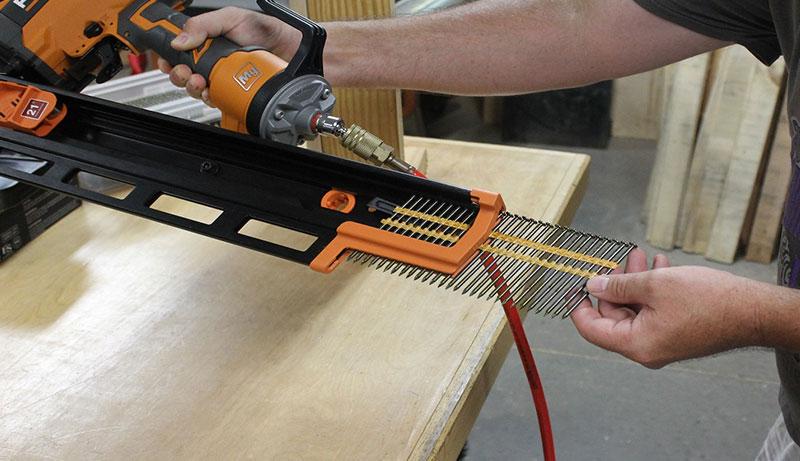
Framing nails aren't all the same. Angle, shank type, collation material, head style, and coating all affect compatibility with your nailer and performance in the field. A 21° plastic-strip nail won't load into a 30° paper-tape nailer. A bright basic nail used on exterior sheathing will rust out in a season. These aren't small details — they're the kind of mistakes that cost you a trip back to the supply house mid-job. If you're investing in a solid home improvement project, starting with the right fasteners saves time, money, and frustration.
In this guide, I've broken down seven of the top-performing framing nails available in 2026. Whether you're running a 21° round-head nailer on interior framing or a 30° clipped-head gun on engineered lumber, there's a pick here for your setup. I've covered specs, real-world performance, compatibility, and the trade-offs you need to weigh before you buy. Let's get into it.

Contents


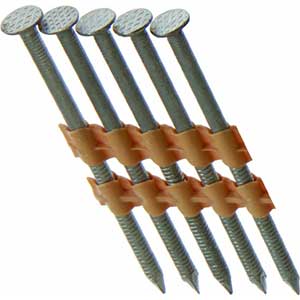
If you want one box of framing nails that works in virtually any round-head 21° plastic-strip nailer and holds up to exterior conditions, this is it. Metabo HPT's 20163SHPT checks every box: 3-1/4" length, .131" diameter, full round head, smooth shank, and hot-dipped galvanized coating. That HDG coating isn't decorative — it's the standard for pressure-treated lumber compatibility and exterior applications where moisture exposure is a real concern.
These ship 1,000 per box in plastic strip collation, which feeds smoothly through most major nailers including Hitachi, Bostitch, Ridgid, and Dewalt 21° tools. The full round head is important here — it gives you maximum surface coverage for pull-through resistance and meets most building codes for structural framing. If your jurisdiction requires full-head nails (and many do for shear walls and hold-down connections), clipped-head nails won't pass inspection. These will.
In the field, drivers report consistent strip feeding with minimal jams and clean, flush seating in both dimensional lumber and OSB sheathing. The .131" shank diameter is the standard structural spec for most 16d common equivalents. At 1,000 count per box, you can frame a typical wall section without reloading every few minutes. These are the nails professional framers keep in the truck as their go-to.
Pros:
Cons:
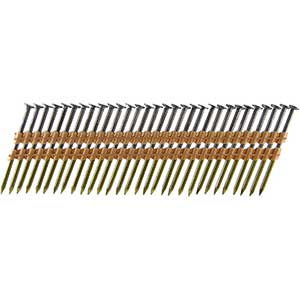
When you need volume without sacrificing quality, the 15105HPT delivers. At 2,500 nails per box, this is the pick for production framers who are burning through multiple boxes per day and need to control material costs without compromising. The 3" x 0.120" smooth shank clipped-head design is the standard for 30° paper-tape nailers, compatible with Paslode, Hitachi, and most other 30° tools in the market.
The "Brite Basic" finish means these are uncoated — that's intentional. For interior framing where the lumber stays dry and the nails are never exposed to moisture, bright nails are perfectly appropriate and cost less than galvanized alternatives. You're not paying for a coating you don't need on studs that go inside a conditioned wall. The clipped-head design also allows tighter strip packing, which is why you get 2,500 per box instead of 1,000.
Paper-tape collation strips cleanly and consistently. Paper degrades faster than plastic in wet conditions, which is why you keep these for interior work. But in dry framing scenarios — wall studs, ceiling joists, interior partitions — they run as smoothly as anything else on this list. The value proposition here is hard to beat when you're framing full rooms.
Pros:
Cons:
Grip-Rite has been making collated fasteners for decades, and the GR034HG1M shows why contractors keep coming back to the brand. Exterior galvanized coating protects against corrosion in exposed framing, roof sheathing, and deck substructure where moisture is a constant threat. The 3-1/4" x .131" full round head smooth shank spec matches the Metabo HPT option above, making these a direct competitor — and often a slightly lower price point depending on when you buy.
The diamond-point tip is a real performance feature, not marketing language. It bites into dense lumber and OSB faster than a blunt-cut tip, reducing driving time per nail and cutting down on nailer fatigue over a long day. The thin shank is precision-engineered to drive through wood substrates without pre-splitting in grain-sensitive species. The flexible plastic strip collation feeds smoothly and releases cleanly, which means fewer jams to clear mid-strip.
Grip-Rite specifies compatibility with most 21° round-head framing nailers, and that holds true in practice. If you're running a Bostitch F28WW, a Dewalt DCN692, or a Freeman PFR2190, these load without modification. The galvanized coating also meets the spec for most PT lumber applications, which makes these a solid choice when you're building decks or exterior structures. If you're working on projects where exterior moisture exposure is a factor, the corrosion resistance here is worth the slight premium over bright alternatives. This applies whether you're framing a shed, a deck subframe, or structural exterior sheathing — all of which also connect to finishing work like installing wooden countertops in the adjacent interior space.
Pros:
Cons:
The 30° angle isn't just a nailer spec — it changes the geometry of where you can drive nails. A steeper 30° angle gives your nailer better access to tight corners, joist hangers, and close-quarter framing that a 21° tool can't reach as cleanly. meite's B0F3HT1M5M is built specifically for that scenario: 3-1/2" x 0.131" offset round-head nails on industrial-grade paper tape, engineered for Paslode, Metabo HPT, Grip-Rite, Freeman, and Bostitch 30–34° nailers.
The 3-1/2" length is a meaningful upgrade over the standard 3" offering. In engineered lumber, LVL beams, and double-stud walls, that extra half-inch of penetration adds real withdrawal resistance. The smooth shank is precision-machined for what meite claims is 20% faster driving in dense lumber — a spec that's plausible given the optimized tip geometry. The paper tape collation is industrial-grade, meaning it won't shred under humidity or repeated strip loading the way cheaper collation materials do.
The offset round head design meets IBC/IRC building codes for structural framing, so you won't hit inspection problems using these on load-bearing applications. If your nailer accepts offset round-head nails (verify this before ordering — not all 30° nailers do), these are a standout choice for engineered lumber framing in 2026. One note: electro-galvanized coating provides basic corrosion resistance, but for pressure-treated or fully exterior applications, hot-dipped galvanized is the more durable spec.
Pros:
Cons:
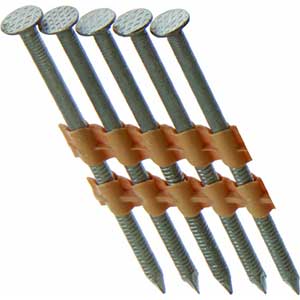
Ring shank nails are the answer when you need maximum withdrawal resistance and standard smooth-shank nails won't hold. The 20302SHPT's annular ring shank creates mechanical interlock with wood fibers as the nail drives in — pull-out force climbs dramatically compared to a smooth-shank equivalent. For subfloor fastening, roof sheathing in high-wind regions, and any application where cyclical loading or moisture-induced wood movement is a concern, ring shank is the right call.
This Metabo HPT option uses a 3" x 0.120" spec, which is slightly narrower than the .131" structural spec. That thinner shank means less splitting risk in drier lumber, and the ring geometry compensates for the reduced diameter by locking into the wood's fiber structure. Hot-dipped galvanized coating keeps corrosion at bay in exterior and semi-exposed applications. Full round head, plastic strip collation, and 21° angle make these compatible with the same broad range of round-head nailers as the smooth shank version.
Where you'll feel the difference between smooth and ring shank is in pull-through testing. Building inspectors in wind zone areas increasingly require ring shank or screw shank fasteners for roof sheathing and wall bracing panels. If you're working anywhere that sees high wind events — or if you want a fastener that stays put regardless of seasonal wood movement — ring shank nails are the upgrade worth paying for. These are also excellent for squeak-resistant subfloor installation where the floor will see repeated traffic loads.
Pros:
Cons:
This is the high-volume interior framing nail. The 15109HPT packs 2,500 nails per box in 30° clipped-head paper-tape collation — the format most common in production framing nailers used by tract home builders and commercial framers. At 3" x 0.131", you get a full-diameter structural shank that meets the spec for interior load-bearing walls, while the bright finish keeps costs down where galvanization adds zero benefit.
The 0.131" shank diameter is the key differentiator over the 0.120" spec. Thicker shank means more steel in the joint, better shear resistance, and a fastener that matches the 16d common equivalent in structural tables. For interior framing — plates, studs, headers, cripples — this is the spec engineers typically reference. The clipped head keeps the collation angle tight and feeds smoothly through 30° nailers designed for that strip geometry.
Running 2,500-count boxes cuts reloading frequency by more than half compared to 1,000-count alternatives. Over the course of a full-day framing push, that's a meaningful productivity gain. The paper-tape strips cleanly and the nails seat flush and consistent. Keep these dry in storage — paper collation doesn't survive prolonged moisture exposure — but on any standard interior framing job, these are a workhorse choice for 2026.
Pros:
Cons:
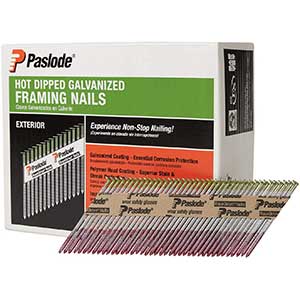
Modern framing increasingly uses engineered lumber — LVL, PSL, LSL — that's denser and harder than standard dimensional stock. Driving cheap nails into engineered lumber means bent tips, stripped strips, and tool jams. meite's B0F62V1282 is engineered specifically to handle that density. The sharp diamond point is the key feature: it shears through engineered wood fiber without pre-drilling, and the 3-1/4" x .131" full round head spec gives you both depth and structural surface coverage.
The hot-dipped galvanized coating exceeds ASTM standards for corrosion resistance, which means these work not just on standard framing but on roof decking, exterior sheathing, and pressure-treated connection points. meite claims the plastic strip collation uses high-tensile adhesive that won't break in extreme temperature swings — a real consideration on job sites that go from sub-zero winter mornings to summer afternoon heat.
Compatibility is broad: Freeman, Bostitch, Dewalt, Milwaukee, and Hitachi 20–22° framing nailers. The full round head shears clean on withdrawal without leaving debris in the nailer mechanism, which meite says cuts maintenance time by 30%. That claim aligns with what you see in production use — these run clean, strip consistently, and seat flush. For mixed-lumber framing where you're switching between engineered and dimensional stock, having a nail that handles both without adjustment is a real job-site advantage. This is also a consideration when planning a comprehensive home project that might involve a fire extinguisher for electrical areas near your framing work — code compliance is a package deal.
Pros:
Cons:
With seven solid options on this list, the right pick comes down to matching four variables: your nailer's angle and collation type, the lumber you're fastening, your local building code, and your job's moisture exposure. Here's how to think through each one.
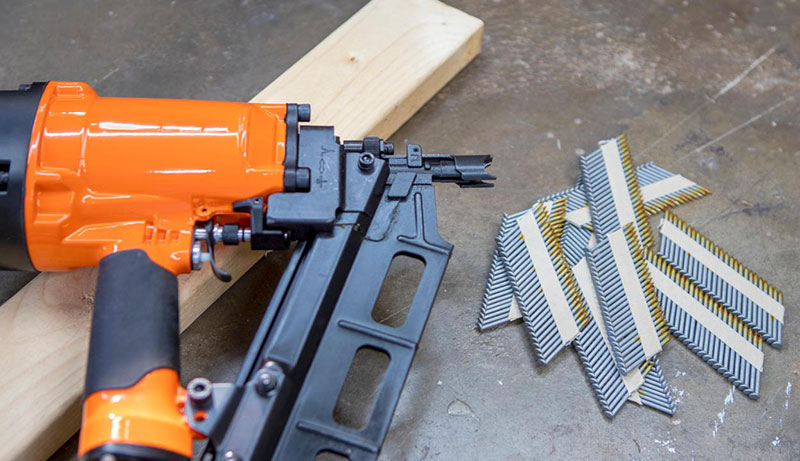
This is non-negotiable. The angle and collation type on the nail box must match your nailer. Using 21° plastic-strip nails in a 30° paper-tape nailer will result in immediate misfeeds and potentially damage your magazine. Check your nailer's manual for the exact collation angle it accepts, and whether it takes plastic strip, paper tape, or wire-weld collation. Then check the head style — full round head vs. clipped head. Some jurisdictions' building codes require full round-head nails for shear wall applications; your nailer may accept both, but your inspector may not.
Smooth-shank nails are the standard for most framing. They drive cleanly, seat flush, and are easy to pull if you need to make corrections. Ring-shank nails trade ease-of-removal for dramatically higher withdrawal resistance. The annular rings lock into wood fiber and create mechanical interlock that smooth shanks can't match.
Coating choice is determined by moisture exposure and lumber type — not by personal preference. Using an uncoated bright nail in exterior or PT applications is a code violation in most jurisdictions, and more importantly, it fails in the field. Galvanic corrosion between uncoated steel and pressure-treated lumber accelerates nail degradation rapidly.
Standard framing nail specs are published in the International Residential Code (IRC). For most residential framing connections, you're looking at 3" to 3-1/4" nails with a 0.120" to 0.131" diameter. The .131" shank is the 16d common equivalent — the spec most structural tables reference for shear wall nailing schedules and rafter-to-plate connections. The 0.120" shank works for standard stud framing but won't satisfy structural hardware manufacturer specifications that explicitly call for .131".
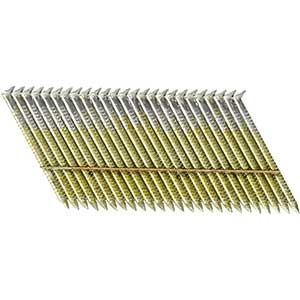
For standard residential framing, the most common spec is 3" to 3-1/4" x 0.131" (16d common equivalent). The IRC specifies 3" minimum for stud-to-plate connections and 3-1/4" for many shear wall nailing schedules. Always check your local building code or engineer-stamped plans — the spec printed there overrides general guidance. For engineered lumber or heavy timber framing, 3-1/2" nails in the same .131" diameter are increasingly common in 2026.
The degree refers to the angle at which nails are collated in the strip — it matches the magazine angle of your nailer. 21° nails use plastic strip collation and are most common in round-head framing nailers from Dewalt, Ridgid, and Bostitch. 30° nails use paper-tape collation and are common in production nailers from Paslode and some Hitachi models. The two formats are not interchangeable — using the wrong angle will misfire, jam, or damage your nailer's magazine. Always confirm your nailer's spec before ordering nails.
Yes — galvanized nails work fine for interior framing. They cost slightly more than bright (uncoated) alternatives, but they're not harmful to use inside. The reverse is what you need to avoid: bright nails used in exterior or pressure-treated lumber applications will corrode rapidly and can cause structural failure over time. If you buy galvanized in bulk, you can use the same nails for both interior and exterior work without managing two separate nail inventories.
It depends on your jurisdiction and application. Many local building codes require full round-head nails for structural framing connections, shear walls, and diaphragm nailing schedules because the full head provides greater surface area and pull-through resistance. Clipped-head nails are accepted in some areas for general framing but are prohibited for shear wall applications in many jurisdictions. Check with your local building department before using clipped-head nails on any structural element — failing inspection is far more expensive than buying the right nails upfront.
Smooth-shank nails are the standard for most framing work — they drive cleanly, seat flush, and can be pulled if needed. Ring-shank nails have annular rings along the shank that lock into wood fiber, creating mechanical interlock that dramatically increases withdrawal resistance. Ring shank is the correct choice for subfloor fastening (prevents squeaks from seasonal wood movement), roof sheathing in high-wind zones, and any PT lumber connection that sees cyclical loads. The trade-off: ring shank nails are nearly impossible to pull without damaging the lumber.
A typical 2,000 sq ft home frame uses between 30,000 and 50,000 nails depending on wall count, floor system complexity, and nailing schedules. A standard interior wall section — 8-foot studs at 16" on-center, plates included — uses roughly 50 to 80 nails. A 1,000-count box covers one to two wall sections. For any project larger than a single room addition, buying 2,500-count boxes significantly reduces cost per nail and reloading frequency. For large-scale jobs, buying by the case (typically 4–5 boxes) is the most cost-effective approach.
The right framing nail is the one that matches your nailer's angle and collation type, meets your local building code's head-style requirement, and has the coating your application demands — and from this list, you have a clear option for every scenario in 2026. Pick the Metabo HPT 21° HDG smooth shank for a reliable all-around performer, go with the Metabo HPT or meite 30° bulk packs for production interior framing, and reach for the ring-shank option any time you need maximum withdrawal resistance in subfloor or wind-zone sheathing. Check your nailer spec, verify your code requirement, order the right box, and frame with confidence.


About Lindsey Carter
Lindsey and Mike C. grew up in the same neighborhood. They also went to the same Cholla Middle School together. The two famillies from time to time got together for BBQ parties...Lindsey's family relocated to California after middle school. They occasiotnally emailed each other to update what's going on in their lives.She received Software Engineering degree from U.C. San Francisco. While looking for work, she was guided by Mike for an engineering position at the company Mike is working for. Upon passing the job interview, Lindsey was so happy as now she could finally be back to where she'd like to grow old with.Lindset occasionally guest posted for Mike, adding other flavors to the site while helping diverse his over-passion for baseball.
You can get FREE Gifts. Or latest Free phones here.
Disable Ad block to reveal all the info. Once done, hit a button below
 im
im