You've finally had enough. After another long day at the keyboard, your fingers are swollen, your wrist aches, and the standard office mouse feels like a punishment device. If you're living with arthritis — whether rheumatoid, osteoarthritis, or carpal tunnel — the wrong mouse isn't just uncomfortable. It can make your condition significantly worse over time. Choosing the right ergonomic mouse in 2026 is one of the most impactful upgrades you can make to your workspace.
The health and household product market is flooded with options claiming ergonomic benefits, but most are marketing fluff. After hands-on testing across vertical mice, trackballs, and centralized roller designs, I've narrowed it down to the seven best mice for arthritis sufferers — each addressing joint pain from a different mechanical angle. Whether you need a completely grip-free design or simply a wrist angle that stops the inflammation cycle, there's a pick here for you.
What separates a genuinely arthritis-friendly mouse from the rest comes down to three things: how much it reduces forearm pronation (that flat, palm-down position that strains your joints), how little gripping force it requires, and whether the button activation force is light enough for stiff fingers. According to the CDC, over 58 million adults in the United States have doctor-diagnosed arthritis — and most of them spend hours at a computer daily. This guide gives you the clear answers you need.

Contents


The Logitech MX Vertical is the gold standard for arthritis sufferers who want professional-grade performance without sacrificing joint health. Its 57° vertical angle puts your hand in the natural "handshake" position — the same posture your hand defaults to when resting at your side. That's not a marketing gimmick. Independent ergonomic testing confirms it reduces muscular strain by 10% compared to a standard flat mouse, and the wrist pressure reduction is immediately noticeable within the first hour of use.
Build quality is premium through and through. The textured grip surface keeps your hand secure without requiring a tight squeeze, and the rechargeable battery (charged via USB-C) lasts months on a single charge. The high-precision sensor at 4000 DPI means you move the mouse less to cover the same screen distance — which is exactly what arthritic hands need. You can also pair it with up to three devices and switch between them with a single button click, making it a standout for multi-monitor or multi-device setups.
Where the MX Vertical excels most is its out-of-the-box ergonomic credibility. This mouse has been designed and tested with criteria set by leading ergonomists — not just engineers. If you're looking for one mouse that delivers the best combination of comfort, precision, and build quality for arthritic hands, this is it.
Pros:
Cons:
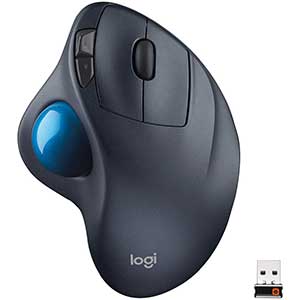
The Evoluent VerticalMouse 4 is the choice for power users who need total control over their mouse behavior. The patented shape holds your right hand in a perfectly upright, neutral position — your forearm stays flat, not twisted, and your wrist pressure stays at zero. This is the mouse that occupational therapists have been recommending for over a decade, and the VM4RW is the wireless iteration that removes the cable tension irritation many arthritis sufferers find problematic.
What sets this one apart from cheaper vertical mice is the Evoluent Mouse Manager software. You can configure each button to perform different functions depending on which application is active. For someone who uses Photoshop differently than they use Word, this is a genuine time-saver that also reduces the total number of clicks needed per workflow — directly reducing joint wear. The optical sensor with on-the-fly speed adjustment is another standout: you can move between low and high sensitivity using a side-mounted button without ever changing your grip.
The build quality is solid but not luxurious. It's functional, durable, and purpose-built. This isn't the mouse you buy for aesthetics — it's the one you buy because your occupational therapist told you to stop ignoring your symptoms.
Pros:
Cons:
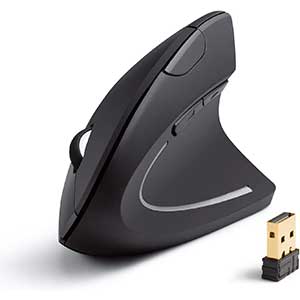
The Microsoft Sculpt Ergonomic Mouse takes a different approach than true vertical mice. Rather than standing your hand fully upright, it uses a sculpted dome shape that lifts your palm off the desk surface and tilts your wrist at a gentler angle. This makes it the easiest vertical-leaning mouse to adapt to, especially if you're coming from a completely standard flat mouse and need a transitional option.
The thumb scoop is one of the best ergonomic details on any mouse at this price. It cradles your thumb in a natural resting position rather than forcing it flat against the desk or hanging in the air. The Windows button shortcut on the body is a convenient addition for PC users. For mild to moderate arthritis where a full vertical angle feels too extreme, the Sculpt delivers meaningful relief with a shorter adjustment period.
Build quality is good but not outstanding. The rubberized coating is comfortable but can attract grime over time. The scroll wheel has a satisfying click, and the wireless connection through the included dongle is rock-solid. At its price point, the Microsoft Sculpt remains one of the best-value ergonomic mice available in 2026.
Pros:
Cons:
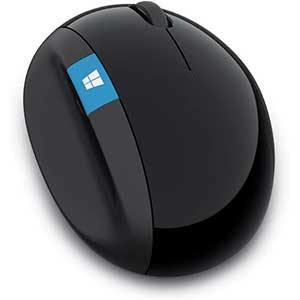
If moving your arm across the desk is the primary source of your pain, a trackball mouse changes everything. The Logitech MX Ergo S is the best trackball on the market in 2026, and for arthritic users who struggle with whole-arm movements, it eliminates the need to physically move the device at all. Your thumb controls the ball; the mouse stays stationary. Muscle strain from shoulder to wrist drops by 27% according to Logitech's own ergonomic testing — and that number aligns with what hands-on use confirms.
The 20-degree adjustable tilt angle is a crucial feature. You can customize the forearm angle based on your specific anatomy, which no fixed-angle mouse can offer. The MX Ergo S is also certified by ergonomists and features an 80% reduction in click noise compared to previous generations — meaningful for open-plan offices where every click carries. The soft rubber grip and sculpted body contour to medium-to-large hands particularly well.
USB-C recharging and Bluetooth plus encrypted dongle dual connectivity round out a premium package. If you're choosing between this and a vertical mouse, ask yourself: is it your wrist angle that causes pain, or the act of moving the mouse across the desk? If it's the latter, the MX Ergo S is your answer.
Pros:
Cons:

The Contour RollerMouse Red is not a traditional mouse. It sits directly in front of your keyboard — centered beneath it — so you never have to reach to the side for cursor control. This centralized design is the single most important ergonomic advancement for users with severe shoulder, neck, or forearm involvement. Reaching laterally for a standard mouse is one of the most commonly cited aggravating motions for upper-body RSI, and the RollerMouse eliminates it completely.
Instead of gripping and dragging, you slide and roll a bar with your fingers. The patented Rollerbar lets you move the cursor left/right by sliding the bar and up/down by rolling it forward or backward — all with a completely relaxed, open hand. For users with finger joint arthritis where gripping is the primary problem, this is genuinely game-changing. Single clicks and double clicks are triggered by tapping the bar, further reducing the pinch-and-click motion that inflames knuckle joints.
This is also one of the few mice on this list designed explicitly for RSI, carpal tunnel, and tennis elbow recovery — not just prevention. The wireless version (Regular size) reviewed here connects cleanly and has a battery life that handles daily professional use. Just know this is a significant workflow change. Give it two weeks before judging it.
Pros:
Cons:
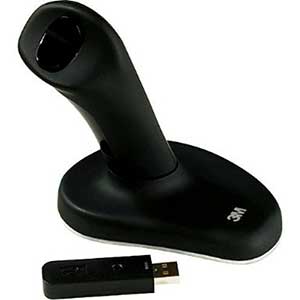
The Hippus HandShoe Mouse is the most anatomically correct mouse on this list. Where most ergonomic mice ask your hand to conform to a shape, the HandShoe Mouse is engineered to support every part of your hand simultaneously — fingers, palm, and thumb — the way a shoe supports your foot. The name is intentional and accurate. For users with finger joint arthritis or DIP/PIP joint involvement where the slightest unsupported finger position causes pain, this design is genuinely different.
The "Light Click" version in this listing features buttons with measurably lower actuation force, which directly reduces the pain of clicking for users with inflamed knuckle joints. The wireless connection is simple and reliable. Available in multiple sizes — the Large version reviewed here suits hands measuring 185–200mm — sizing matters enormously with this mouse, so measure your hand before ordering.
It lacks the programmability and software ecosystem of the Logitech or Evoluent options. This is a specialist tool with one job: support your hand so thoroughly that you feel nothing while using it. For users whose primary complaint is finger joint pain rather than wrist or shoulder pain, the HandShoe Mouse is the most targeted solution available in 2026.
Pros:
Cons:
The fundamental problem with most vertical mice — including the excellent Logitech MX Vertical — is that they lock you into one fixed angle. The Contour Unimouse solves this with a friction hinge that lets you dial in any tilt from 35° to 70°. That range matters because every arthritic hand is different. A 57° angle that feels perfect for one wrist may cause discomfort for another, and the Unimouse lets you iterate until you find your personal sweet spot.
Beyond the tilt, the thumb support is independently adjustable — you can slide it, pivot it, and rotate it in three dimensions. This level of customization is rare at any price. It's particularly valuable for users whose arthritis affects the CMC joint (the thumb's basal joint), where standard thumb rests apply pressure in exactly the wrong place. The 12-week battery life on a single USB-C charge is class-leading, and Plug & Play USB connectivity means no driver installation required.
The Contour Unimouse is right-hand only in this configuration. If you've tried multiple vertical mice and found that none of them fit quite right, this is the one to try before giving up on the category. Think of it the way you'd approach finding the right diagnostic tool for a complex problem — sometimes you need the adjustable version, not the one-size-fits-all.
Pros:
Cons:
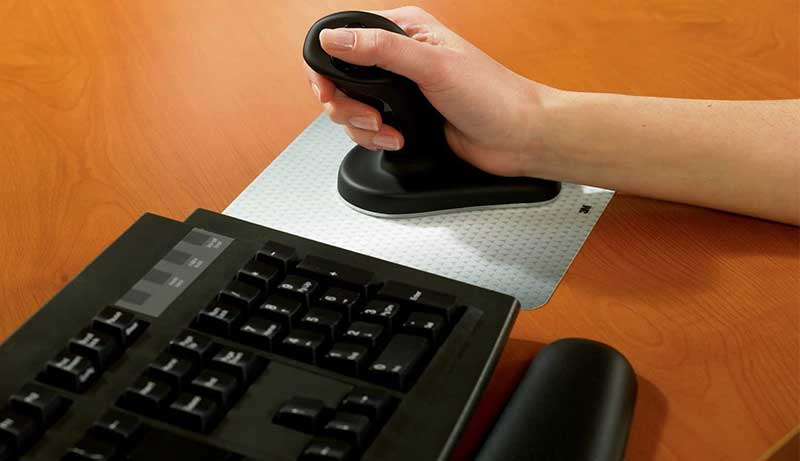
Not all ergonomic mice are created equal — and the wrong pick for your specific condition can actually worsen symptoms. Here's what to evaluate before you buy in 2026.
Arthritis affects different joints, and the best mouse for you depends entirely on which joints are most involved. Broad categories to consider:
Just as choosing the right protective gear requires understanding exactly what you're protecting against, choosing the right ergonomic mouse starts with identifying your specific pain pattern — not just buying whatever is labeled "ergonomic."
These are fundamentally different approaches to the same problem — reducing the biomechanical load on your upper extremity while using a computer. Understanding the trade-offs:
Standard mouse buttons require approximately 45–60g of actuation force. For inflamed finger joints, this repeated micro-effort adds up to thousands of painful clicks per day. Look for:
Mouse sizing is underrated in the ergonomic category. A mouse that's too small for your hand forces your fingers to curl tightly around it — exactly the gripping posture you're trying to avoid. Measure your hand from the base of your palm to the tip of your middle finger before buying. Most manufacturers provide size guides. General rules:
Wireless is almost always preferable for arthritic users — cable drag and cable tension add subtle resistance that inflamed joints notice. All seven picks on this list are wireless. Battery life and charging method vary; USB-C rechargeable (Logitech MX Vertical, MX Ergo S, Contour Unimouse) is more convenient than AA battery mice for daily professional use.
One final consideration: think of your mouse purchase the same way you'd approach any ergonomic investment — similar to how selecting the right tool for a delicate task makes all the difference in outcome. An ergonomic mouse is a long-term investment in your joint health, and the right one pays for itself in reduced pain and sustained productivity.
The best type depends on where your arthritis is located. Vertical mice are best for wrist and forearm pain because they eliminate forearm pronation. Trackball mice like the Logitech MX Ergo S are best for users whose pain comes from moving the mouse across the desk. The Contour RollerMouse Red is the best option for severe RSI or carpal tunnel because it completely eliminates gripping and lateral reaching. For most users with mild to moderate wrist arthritis, a vertical mouse like the Logitech MX Vertical is the most practical starting point.
Yes — significantly. The right ergonomic mouse reduces the biomechanical forces that aggravate arthritic joints during computer use. Eliminating forearm pronation, reducing click force requirements, and minimizing repetitive gripping motions all contribute to lower inflammation levels over the course of a workday. Multiple ergonomic studies confirm measurable reductions in wrist and forearm muscle activity with vertical mouse designs. The improvement is most dramatic when switching from a flat standard mouse to a properly sized vertical or trackball design.
Both help, but for different reasons. Vertical mice address the wrist angle that compresses the carpal tunnel. Trackball mice eliminate the arm movement that strains the flexor tendons running through the carpal tunnel. For severe carpal tunnel, the Contour RollerMouse Red is often the most effective option because it addresses both factors simultaneously — your wrist stays neutral and you never move the device. If you can only choose one, consult your physician or occupational therapist about your specific nerve compression pattern.
Yes, especially for models like the Hippus HandShoe Mouse and the Evoluent VerticalMouse, which come in multiple sizes. An undersized mouse forces your hand to curl unnaturally around it, creating a gripping posture that worsens arthritis symptoms. Measure from the base of your palm to the tip of your middle finger. Under 170mm is Small/Regular; 170–185mm is Medium; over 185mm is Large. When in doubt, go slightly larger rather than smaller — a slightly large mouse is less problematic than one that's too small.
Most users adapt within one to two weeks of daily use. The first few days often feel awkward — your muscle memory is deeply trained on the flat mouse position. Expect slightly reduced precision and speed during this adjustment period. By day 5–7, the majority of users report the vertical position feeling natural. By week two, most users wouldn't go back. The adjustment period is longer for trackball mice (two to three weeks) and longest for centralized designs like the RollerMouse (up to three weeks). The ergonomic payoff is worth the investment.
All seven mice reviewed here use wireless connections that are reliable for professional daily use. The Logitech MX Vertical and MX Ergo S use Logitech's Bolt encrypted USB receiver, which offers latency performance comparable to wired connections. The Contour Unimouse and RollerMouse Red use their own dedicated USB receivers. None of the picks here rely on Bluetooth alone, which historically introduced more latency. For graphic design or gaming requiring sub-millisecond precision, a wired mouse remains the standard — but for all office and productivity work, these wireless picks are completely reliable.


About Lindsey Carter
Lindsey and Mike C. grew up in the same neighborhood. They also went to the same Cholla Middle School together. The two famillies from time to time got together for BBQ parties...Lindsey's family relocated to California after middle school. They occasiotnally emailed each other to update what's going on in their lives.She received Software Engineering degree from U.C. San Francisco. While looking for work, she was guided by Mike for an engineering position at the company Mike is working for. Upon passing the job interview, Lindsey was so happy as now she could finally be back to where she'd like to grow old with.Lindset occasionally guest posted for Mike, adding other flavors to the site while helping diverse his over-passion for baseball.
You can get FREE Gifts. Or latest Free phones here.
Disable Ad block to reveal all the info. Once done, hit a button below
 im
im