You're standing in the electrical aisle — or scrolling Amazon at midnight — trying to decide if the leads that came with your multimeter are good enough, or if you should upgrade. Then you read one too many forum posts about leads failing mid-measurement, or worse, sparking under load. That's usually the moment people start taking test lead quality seriously. In 2026, it's a decision worth making deliberately.
The thing is, multimeter test leads aren't all the same. Insulation rating, probe tip design, wire flexibility, and accessory compatibility all vary significantly across price points. A set rated for CAT III 1000V isn't the same as a budget pair labeled "1000V" with no CAT classification. If you're doing any serious electrical work — panels, automotive diagnostics, HVAC, or industrial equipment — the difference matters.
This guide covers seven top-rated test lead sets for 2026, from Fluke's industry-standard safety-focused options to full-featured modular kits loaded with accessories. We break down exactly what each set does well, where it falls short, and who it's best for. For more gear in this space, check out our tech and electronics category. And if you need related tool upgrades, our roundup of the best impact socket adapters is worth a look while you're at it.
Contents





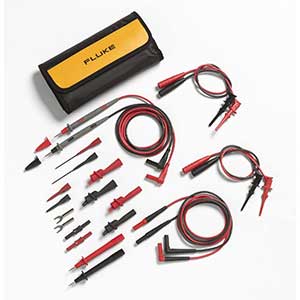
If you're doing live electrical work on panels, switchgear, or any application where tip exposure is a genuine hazard, the Fluke TL175 is the set you want in your hand. The patented TwistGuard extendable tip shroud is the defining feature here — you twist the shroud to expose only as much probe tip as you actually need, dramatically reducing the chance of accidental contact with adjacent conductors. It's not a gimmick. In tight panel work, this design actively reduces arc flash risk.
The insulation system is another standout. Fluke wraps these leads in two layers of silicone — and the inner layer is a contrasting color, functioning as a built-in wear indicator. When the outer insulation gets nicked or abraded, you'll see the inner color through the damage. You'll know exactly when your leads need replacing, instead of discovering it mid-job. The silicone construction stays flexible across a wide temperature range, which matters when you're working in cold utility vaults or hot industrial environments.
These leads meet the highest electrical safety requirements and are designed to work with most standard banana plug multimeters. The 2mm diameter probe tips fit into recessed test ports that standard 4mm tips can't reach, adding versatility. Build quality is unmistakably Fluke — these feel built to last years of daily professional use.
Pros:
Cons:
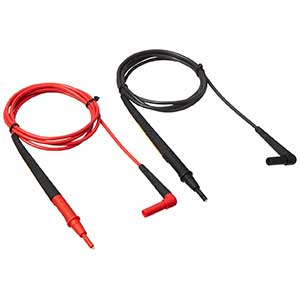
The Fluke TL224 takes a different approach from the TL175 — instead of specialized safety shrouds, it focuses on ergonomics and everyday reliability. The SureGrip handle design gives you a secure, comfortable hold during extended testing sessions. The right-angle connector on one end and straight connector on the other is a thoughtful detail: the angled plug reduces strain on the multimeter's input jacks during awkward measurements, and it keeps the cable from kinked up against the body of the meter.
Safety shrouding on the banana plugs meets IEC and CE standards, and the reinforced strain relief at both connector ends is noticeably beefy — this is where budget leads usually fail first, and Fluke addresses it head-on. The standard diameter banana plugs fit virtually every multimeter on the market. Red and black color coding is clear and consistent.
If you do a lot of bench work, lab testing, or field measurements where you're not working in high-exposure panel environments, the TL224 offers Fluke's build quality and brand confidence at a more accessible price point than the TL175. It's the go-to recommendation for technicians who want professional-grade leads without the specialized safety features they don't need daily.
Pros:
Cons:
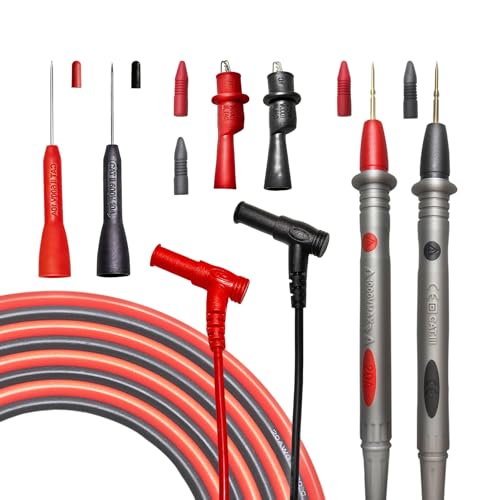
The WIUYNTLZ kit punches well above its price class. The headline spec is the 49-inch (125cm) silicone leads — 25% longer than most standard kits — which is a genuine quality-of-life upgrade when you're measuring across a large panel or keeping your hands clear of energized components. The silicone compound stays tangle-free and flexible from -58°F to +392°F, so it performs in cold garages and hot engine bays alike.
Safety ratings are legitimate: the main leads and gold-plated probes carry a CAT III 1000V 20A rating, making this kit suitable for industrial and electrical panel applications. The alligator clips are CAT III 10A, and the 0.8mm back probe needles are CAT II rated. That's a well-thought-out set of ratings for a multi-use kit. The 0.8mm ultra-fine back probe needles are a standout feature — they slide into sealed automotive connectors without damaging the seals, which is exactly what you need for proper automotive diagnostics without voiding your work.
Compatibility with Fluke, AstroAI, Klein, and other popular multimeters is confirmed. The gold-plated probe tips resist corrosion and maintain reliable contact resistance over time. For the price, you're getting a safety-rated, full-featured kit that competes with sets costing twice as much. If you want one kit that handles electrical work, automotive diagnostics, and electronics — this is your pick.
Pros:
Cons:
Amprobe doesn't get talked about as much as Fluke — despite being part of the same parent company — but the TL35B is a solid, no-nonsense set that gets the job done at a price that doesn't sting. The 40-inch PVC-insulated leads are a reasonable length for most bench and field applications, and the shrouded 90-degree banana plugs offer the same jack-protection benefit you get with the Fluke TL224, at a fraction of the cost.
The included alligator clips are the real value-add here. Large threaded clips with a 0.6-inch jaw are big enough to clamp onto most terminals, battery posts, and component leads without slipping. For continuity testing, battery testing, or any measurement where hands-free operation saves you time, having those clips integrated into the set is genuinely useful. Both leads and clips come in red and black for clear polarity identification.
PVC insulation isn't as flexible or temperature-resistant as silicone, and you'll notice that in cold weather — the leads get stiffer than you'd like. But for home workshop use, electronics hobbyists, or technicians who need a capable backup set, the TL35B delivers Amprobe's quality reputation at a price point that makes it easy to keep a spare kit around.
Pros:
Cons:
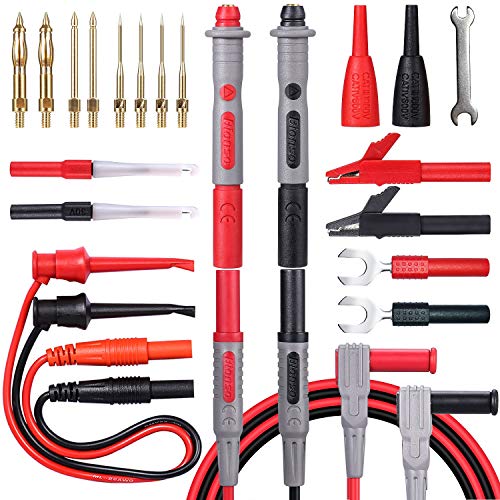
Twenty-five pieces sounds like a lot — and the Bionso kit actually justifies that number. The silicone leads are soft and genuinely flexible, rated for cold and high-temperature resistance, and double-insulated with 100 high-purity copper conductors inside. Low resistance and no signal loss are claims the build quality backs up: the conductors are dense and the connections are solid throughout. This isn't a kit where you'll find thin wire crimped into a flimsy plug.
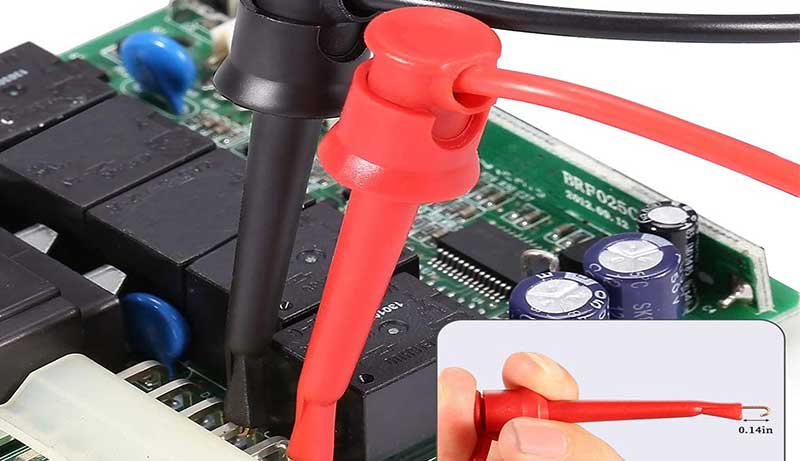
What makes the Bionso stand out in the mid-range category is the replaceable probe system. The gold-plated probes unscrew and swap out, so when one gets bent or worn down, you replace the tip — not the whole lead. The included accessories cover the main bases: alligator clips for hands-free work, test hooks for grabbing onto wire insulation or component leads, and back probe pins for accessing sealed connectors. For anyone doing a variety of electronic work — from circuit boards to automotive wiring — this kit adapts to the job.
The grip texture on the probe handles is comfortable and tactile, giving you confident control when probing small PCB pads or tight terminal blocks. At its price point, the Bionso 25-piece is one of the better all-around kits available in 2026 for someone who wants versatility without paying Fluke prices for every accessory.
Pros:
Cons:
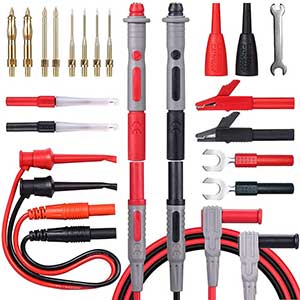
Fieldpiece built its reputation in the HVAC/R industry, and the ADK7 is the test lead kit designed specifically for technicians working in that world. The kit bundles three components that are genuinely useful together: the ADLS2 silicone leads, ASA2 alligator clip extensions, and RCT2 extended-reach Molex probes. That last accessory is what separates this from a generic kit — the Molex probes reach into recessed connector housings that standard probes simply can't access, which is a daily requirement in HVAC control boards and refrigeration equipment.
The silicone leads are engineered to stay supple in freezing temperatures — critical when you're diagnosing a heat pump in winter — and heat-resistant up to 302°F for work near furnaces and condensers. Tangle-free design holds up through a full day of pulling leads in and out of a bag. The alligator clip extensions enable hands-free continuity testing, which is especially useful when paired with Fieldpiece stick meters for one-handed voltage checks in tight equipment cabinets.
If you're not an HVAC tech, the Fieldpiece ADK7 is probably more specialized than you need. But if you are, this kit was built for your work environment specifically, and it shows. The extended Molex probe compatibility alone makes it worth the investment over a generic kit. Just as a quality plug cutter makes the difference in precision woodworking, purpose-built tools matter in HVAC diagnostics too.
Pros:
Cons:
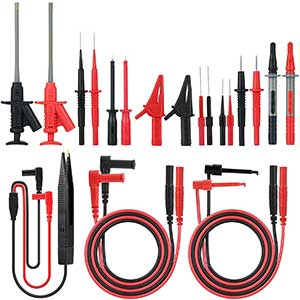
The Neoteck 17-piece kit is built with automotive technicians in mind, and the wire-piercing probes are the reason to own it. These piercing probes puncture through wire insulation to make contact with the conductor without you having to strip or damage the cable. That's a significant time-saver during automotive diagnosis, and it means you can test live circuits without creating permanent damage to the wiring harness. The included wrench ensures the probe-to-lead connection stays tight and doesn't pull loose mid-measurement.
The leads use double-insulation with flexible PVC construction and carry strong conductivity ratings with low resistance throughout the system. The replaceable gold-plated probe tips swap out easily, which extends the useful life of the kit considerably. The overall build quality is solid for the price bracket — the connection points are reinforced and the banana plugs seat firmly in standard 4mm ports.
PVC flexibility is adequate for most automotive shop environments but won't hold up in extreme cold as well as silicone. That said, if you're diagnosing wiring faults, testing sensors, or doing voltage drop tests on vehicle circuits, the piercing probes alone make this kit worth owning. It covers a gap that most general-purpose kits simply don't address.
Pros:
Cons:
Buying test leads isn't complicated, but there are a few decisions that make a real difference in safety and usability. Here's what to prioritize in 2026.
The CAT (Category) rating system classifies test leads by the type of electrical environment they're safe to use in. This isn't marketing language — it's an IEC-defined safety standard that determines how much transient voltage the leads can withstand without failure. Here's a quick breakdown:
If you work on electrical panels, demand CAT III at minimum. A lead labeled "1000V" without a CAT rating is not equivalent to a CAT III 1000V lead — the voltage rating alone doesn't tell you how the leads handle high-energy transients.
You'll encounter two main insulation materials across most test lead sets on the market today:
For most professional applications in 2026, silicone is worth the modest price premium. The flexibility and temperature range pay dividends in real-world conditions.
Standard pointed probes cover most measurement scenarios. But depending on your work, you may need more:
If you're doing one type of work, a focused kit like the Fluke TL175 makes sense. If you need versatility across applications, the WIUYNTLZ or Bionso kits give you the breadth.
Standard test leads typically run around 36 to 40 inches. That's enough for most bench and handheld meter applications. If you regularly measure across large equipment or need your hands clear of energized components, 49-inch leads make a tangible difference. The WIUYNTLZ kit's extra length is one of its most practical advantages.
Connector compatibility is rarely an issue — virtually all modern multimeters use the standard 4mm banana plug. However, some multimeters (particularly older Fluke meters and specialized instruments) use recessed input jacks that require shrouded banana plugs. Check your meter's documentation if you're unsure. Right-angle connectors, like those on the Fluke TL224, reduce wear on the input jacks during side-angle measurements.
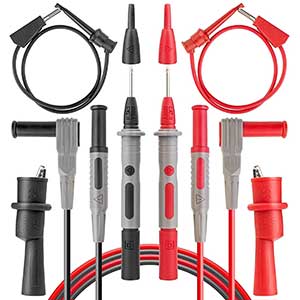
For residential and commercial electrical panel work, you need CAT III rated leads at minimum. CAT III covers distribution-level wiring, panel boards, junction boxes, and fixed equipment — the environments you'll encounter inside a breaker box. If you're working at the utility service entrance or meter socket, step up to CAT IV. Never use leads without a CAT rating on live panel circuits, regardless of the voltage number printed on the leads.
Most multimeters use standard 4mm banana plug connectors, and the vast majority of test leads use the same standard — so physical compatibility is rarely an issue. However, your leads should always match or exceed the CAT rating and voltage/current rating of your meter. Using leads with a lower safety rating than your meter is rated for defeats the meter's safety design. Check your multimeter's manual for its input specifications before buying leads.
Silicone insulation stays flexible across extreme temperatures (typically -58°F to +392°F), resists oils and chemicals better, and maintains pliability in cold environments. PVC is stiffer, especially in cold weather, and has a narrower temperature operating range. For professional field work — automotive, HVAC, outdoor electrical — silicone is the clear choice. For bench work at controlled room temperatures, PVC leads perform adequately and cost less.
Back probe pins are ultra-fine needle probes — typically 0.8mm diameter — designed to slide into sealed automotive wire connectors from the back (wire entry side) without damaging the seals. When you need to measure voltage or continuity on a live automotive circuit without unplugging the connector or stripping wire, back probe pins are the right tool. They're essential for diagnosing sensors, actuators, and ECU wiring while the connector stays plugged in and the circuit stays intact.
Replace your leads immediately if you see any cracks, cuts, or exposed conductor through the insulation. The Fluke TL175 WearGuard feature makes this easier — the dual-layer insulation exposes a contrasting color when the outer layer is damaged. On standard leads, inspect the insulation visually before every use, particularly at the probe handles and near the banana plugs where flex stress is highest. Also replace leads if the continuity reading on a known-good circuit becomes intermittent, which indicates a broken conductor inside the lead.
Factory-included leads are designed to match the meter's specifications, but build quality is often minimal — thin insulation, basic probe tips, and no safety certification documentation. For low-stakes home use, they'll do the job. For any professional application, for work on live circuits, or for environments requiring certified CAT-rated equipment, upgrade to a dedicated quality set. The cost of proper leads is trivial compared to the cost of a meter, and the safety margin is not trivial at all.


About Lindsey Carter
Lindsey and Mike C. grew up in the same neighborhood. They also went to the same Cholla Middle School together. The two famillies from time to time got together for BBQ parties...Lindsey's family relocated to California after middle school. They occasiotnally emailed each other to update what's going on in their lives.She received Software Engineering degree from U.C. San Francisco. While looking for work, she was guided by Mike for an engineering position at the company Mike is working for. Upon passing the job interview, Lindsey was so happy as now she could finally be back to where she'd like to grow old with.Lindset occasionally guest posted for Mike, adding other flavors to the site while helping diverse his over-passion for baseball.
You can get FREE Gifts. Or latest Free phones here.
Disable Ad block to reveal all the info. Once done, hit a button below
 im
im