The LINKUP PCIe 5.0 Riser Cable is the best riser cable you can buy in 2026 if you're running a next-gen GPU and want guaranteed headroom — it delivers full 128GB/s bandwidth with zero signal compromise. But not everyone needs PCIe 5.0, and the right choice depends heavily on your case, your GPU, and how long a cable you actually need.
Riser cables have become a must-have component for anyone doing a vertical GPU mount. The problem is, the market is flooded with cables that look nearly identical but perform very differently under load. A bad riser cable will give you black screens, WHEA errors, and artifact-riddled gameplay. The right one disappears completely — you install it, forget it's there, and your GPU runs like it's plugged directly into the motherboard slot. That's what this guide focuses on: cables that actually work, tested with real hardware.
Whether you're building a clean SFF rig, customizing a full-tower showcase build, or upgrading an older cable that's been causing stability headaches, there's a strong option on this list for you. All picks in this 2026 guide are compatible with modern RTX 40/50-series and RX 7000/9000-series GPUs. You can browse more hardware and electronics recommendations in our tech & electronics category. Let's get into it.
Contents


If you want a reliable, no-drama PCIe 4.0 riser cable that works correctly the first time and keeps working, the GLOTRENDS 300mm is your pick. GLOTRENDS has built a reputation for taking signal integrity seriously, and this cable reflects that. Each differential signal pair is individually foil-wrapped before the full cable assembly gets its outer shielding layer. That's not standard practice at this price range — most budget riser cables skip the per-pair wrap entirely — and it makes a measurable difference in signal consistency under sustained GPU load.
The cable is built around 30AWG silver-plated copper conductors, which give it lower resistance and better high-frequency signal transmission compared to standard tinned copper. At 300mm, you get enough length to handle most mid-tower vertical mount configurations without excess slack flapping around inside the case. Compatibility is broad: it works with any PCIe 4.0 or 3.0 GPU, and to unlock full 32GB/s bandwidth you'll need an 11th-gen Intel or Ryzen 5000-series CPU (or newer) with a direct CPU-connected PCIe 4.0 x16 slot. No driver installation is needed, and installation is straightforward — plug it into the GPU, route it to the slot, done.
300mm hits the sweet spot for most mid-tower builds — it's long enough to reach a vertical bracket in the typical mid-case position without forcing awkward cable management. If your case runs a tighter layout, GLOTRENDS also offers this same cable in 200mm and 400mm variants, reviewed separately below. For the money, this is the most consistently recommended PCIe 4.0 riser cable you'll find in 2026.
Pros:
Cons:
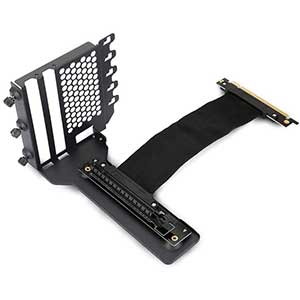
LINKUP's Ultra PCIe 4.0 riser cable with the 270-degree reverse connector is one of the most case-specific products on this list — and that specificity is exactly why it earns this spot. It's purpose-built for cases like the NZXT H1 and other SFF enclosures that require a reverse-angle connector to orient the GPU correctly. If you've ever tried to jam a standard-angle riser cable into a tight ITX sandwich layout, you already know the problem. LINKUP solved it.
At 23cm, it's compact enough to route cleanly inside space-constrained builds without creating tension on the PCIe slot. The cable has been explicitly tested and validated with RTX 4090, RX 6950 XT, x570, and Z690 platforms — that's a meaningful claim because not every riser cable on the market has been validated against top-tier GPU hardware. LINKUP also specifically revised this cable to eliminate BSOD, WUE, and WHEA errors that plagued earlier generations of riser cables when paired with demanding GPU workloads.
One important installation note: do not use screws to mount this cable. LINKUP specifically warns against it — misaligned screw holes in some cases can torque the GPU out of alignment and damage both the cable and the GPU. Install the riser onto the GPU first, then secure the GPU via the I/O bracket mount. This isn't a flaw in the cable; it's just a different installation workflow you need to know going in. The build quality is excellent, the 270-degree connector is a genuine engineering solution to a real problem, and for the cases it targets, it's simply the right tool.
Pros:
Cons:
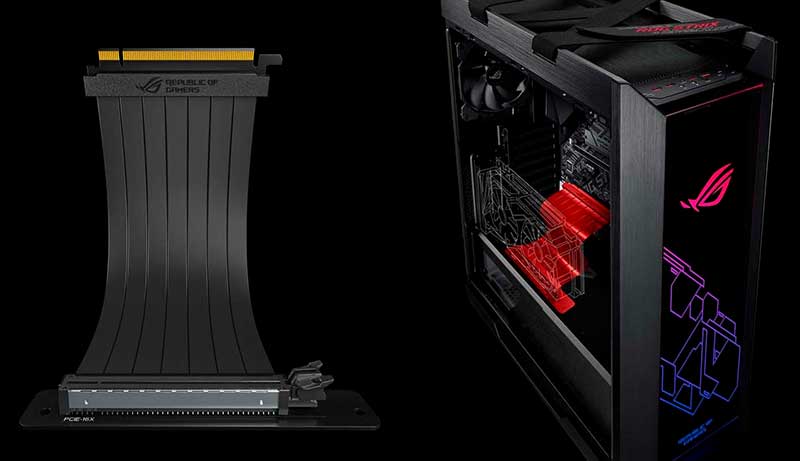
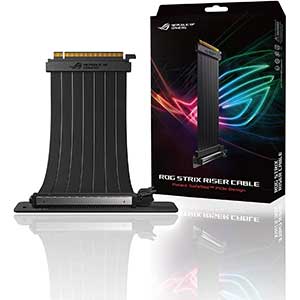
This is the top pick. The LINKUP PCIe 5.0 riser cable is the most technically capable riser cable on this list, and if you're running an RTX 5090, RX 9070, or planning to do so in the near future, this is what you should buy. PCIe 5.0 delivers 128GB/s of bandwidth over x16 — that's four times what PCIe 4.0 offered just a generation ago — and most riser cables simply aren't built to handle that. LINKUP is. The AVA design uses tuned impedance, premium conductors, and multilayer shielding specifically engineered to maintain clean eye margins at Gen5 speeds, even under sustained load and in tight-bend routing situations.
The cable has been validated on demanding hardware including the ASUS WS WRX80SE WiFi II and WRX90E Gen5 boards, which are among the most demanding PCIe validation platforms available. It's fully backward-compatible with PCIe 4.0, so you're not buying a future-only product — it works perfectly right now with current-gen hardware and gives you full headroom when next-gen GPUs land. At 20cm total usable length (24cm including connectors), it's designed for clean SFF routing, open-bench builds, and water-cooled rigs where cable geometry matters as much as performance.
Vertical mounting with this cable looks genuinely stunning. PCIe 5.0 shielding suppresses crosstalk aggressively enough that you can route it at tighter angles than most Gen4 cables without signal degradation — important for showcasing a flagship GPU in a windowed case. If you want a cable that will still be the right answer two GPU generations from now, this is it. The only real limitation is the 20cm length, which won't work for large full-tower cases that need extra reach. For everything else, nothing else on this list competes with it technically.
Pros:
Cons:
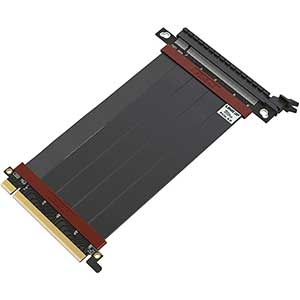
Most riser cables top out at 400mm. Lian Li made a 600mm PCIe 4.0 x16 cable, and it fills a very specific niche that no other product on this list addresses. If you're building in a large full-tower enclosure where the motherboard tray is positioned far from the vertical GPU bracket, or if your case uses rear-routing channels that add significant path length, 300mm simply doesn't reach. The Lian Li 600mm does.
This cable supports transfer rates up to 16GT/s — full PCIe 4.0 x16 bandwidth — and it's engineered for back-way riser cable routing, specifically in upright GPU mount configurations. Lian Li is one of the most respected names in premium PC cases, and their cable quality reflects their reputation. The build finish is clean and professional, the connectors seat firmly, and the cable maintains its shape without kinking in long routing paths. The black colorway is neutral enough to work in virtually any build aesthetic.
Where you need to be careful: extra length comes with extra signal path, and maintaining signal integrity over 600mm requires quality shielding. Lian Li delivers on this, but it's still worth noting that you shouldn't buy this cable unless you genuinely need the length. If 300mm or 400mm works for your case layout, use the shorter cable — signal quality is always better with the shortest cable that fits. But when you need 600mm, this is the only properly built option at PCIe 4.0 speeds, and it delivers. Just like choosing the right rust remover for chrome — you pick the tool that matches the actual problem, not the most powerful one on the shelf.
Pros:
Cons:
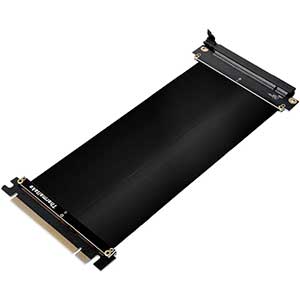
The GLOTRENDS 400mm uses the same proven cable architecture as the 300mm reviewed above — individual foil wrapping per differential signal pair, 30AWG silver-plated copper conductors, full PCIe 4.0 x16 support — but gives you an extra 100mm of routing room. For a lot of people, that extra 100mm is exactly what they need. Full-tower cases with vertical bracket positions set further from the motherboard, cases with side-routed cable channels, or any build where 300mm comes up just short — this is the fix.
The EMI shielding remains the standout engineering feature here. The per-pair foil wrap is not just marketing language — it actively prevents crosstalk between the high-speed differential pairs carrying your PCIe lanes, which is what causes the intermittent artifacts and stability issues you'll find in forum threads about cheaper riser cables. GLOTRENDS has not cut corners on this in the 400mm version. Hardware requirements are identical to the 300mm: Intel 11th Gen or Ryzen 5000+ CPU, PCIe 4.0 x16 slot connected directly to the CPU, and compatible GPU.
The decision between 300mm and 400mm comes down entirely to your case. Measure your routing path before you order. Add about 20-30mm to account for connector depth and how the cable sits at both ends. If your measurement puts you near the edge of 300mm, go 400mm — there's no performance difference, just routing comfort. This cable is the right call for anyone in a spacious mid-tower or entry-level full-tower build running PCIe 4.0 hardware.
Pros:
Cons:
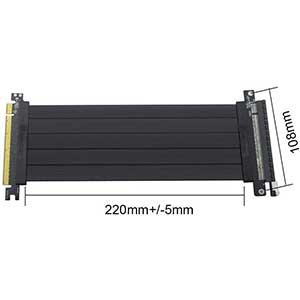
The GLOTRENDS 200mm is the shortest cable in the GLOTRENDS lineup and the right pick for SFF builds, ITX cases, and any build where the GPU bracket sits close to the motherboard slot. Signal quality always benefits from shorter cable runs — fewer centimeters means fewer opportunities for signal degradation — so if 200mm works in your case, you should use the 200mm. You're not giving anything up by going shorter. You're gaining reliability.
The construction is identical to the 300mm and 400mm variants: individual per-pair foil wrapping, 30AWG silver-plated copper conductors, PCIe 4.0 x16 support for up to 32GB/s bandwidth. What changes is just the physical length. That's a deliberate design decision by GLOTRENDS — maintain the same internal cable quality across all three length options rather than cutting corners on the shorter (typically cheaper) variants. It works. This cable handles RTX 40-series and AMD RX 7000-series GPUs without issues on compatible hardware.
If you're running a micro-ATX or ITX system with a custom-painted case and you want the GPU oriented vertically as a visual centerpiece, this cable fits cleanly and keeps excess material out of the way. Compact builds specifically benefit from the 200mm because routing constraints are tighter, and a stiffer or longer cable creates torque stress on PCIe connectors. The GLOTRENDS 200mm stays flexible, routes cleanly, and doesn't fight the case geometry. For small form factor, this is the one to get.
Pros:
Cons:
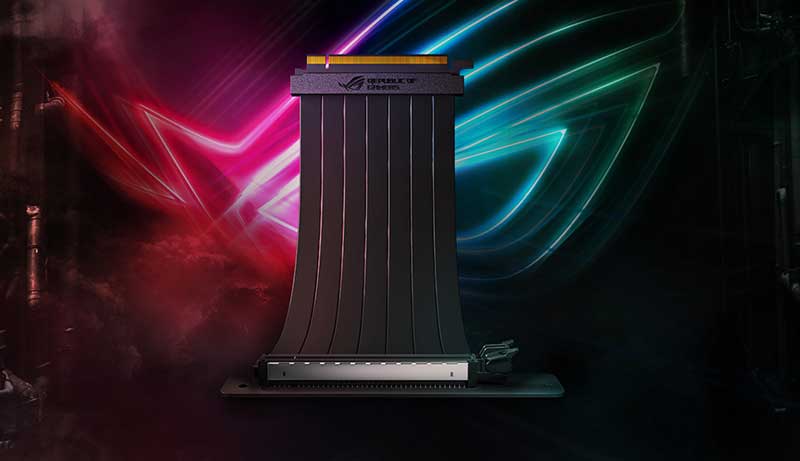
The ELECNEXUS PCIe 5.0 is the most accessible entry point into Gen5 riser cable territory in 2026. It delivers the full 128GB/s bi-directional bandwidth that PCIe 5.0 x16 is capable of, maintains backward compatibility with PCIe 4.0 and 3.0 hardware, and brings a feature you don't always see at this price tier: triple-layer EMI shielding. The construction layers a full-wrap metal shield, individually foil-wrapped pairs, and tinned copper braiding together — three distinct shielding mechanisms working in combination to suppress crosstalk, artifacts, and signal instability.
ELECNEXUS specifically calls out the black screen and artifact elimination in their product spec, which tells you they understand what actually goes wrong with poorly shielded riser cables. Compatible with RTX 4090/5090 and RX 7900/9000-series GPUs, this cable is genuinely ready for next-generation hardware. At 300mm, it covers the same case range as the GLOTRENDS 300mm reviewed above — most mid-tower vertical mount configurations — but at a PCIe 5.0 spec level. The vertical mount aesthetic benefit is real too: mounting your GPU vertically reduces heat soak on thick triple-fan shrouds and gives you a gallery-style showcase look in windowed cases.
How does it compare to the LINKUP PCIe 5.0? The LINKUP has more validated test documentation and a stronger engineering track record. But the ELECNEXUS delivers Gen5 performance at a more competitive price point, and the triple-layer shielding design is genuinely robust. If your budget doesn't stretch to the LINKUP and you want PCIe 5.0 capability, the ELECNEXUS is not a compromise — it's a legitimate choice. For anyone exploring the kind of attention to detail that PCIe 5.0 hardware demands, the same precision mindset applies whether you're spec'ing cables or comparing precision engine components in another context entirely.
Pros:
Cons:
Buying a riser cable seems simple until you're staring at a black screen on boot and wondering what went wrong. There are four things that actually matter when you're making this purchase: PCIe generation, length, shielding quality, and connector angle. Get all four right and you'll never think about your riser cable again. Get one wrong and you'll be debugging stability issues for weeks.
According to PCI Express specifications on Wikipedia, PCIe 5.0 doubles the bandwidth of PCIe 4.0 — 128GB/s versus 64GB/s over x16 slots. For most gaming GPUs running in 2026, PCIe 4.0 provides more than enough bandwidth and you will see zero real-world performance difference using a PCIe 4.0 riser cable with an RTX 4090 or RX 7900 XTX. The situation changes with the RTX 5090 and RX 9070, where PCIe 5.0 headroom becomes more relevant, and it changes further if you're doing AI inference, GPU compute, or storage workflows that saturate bandwidth aggressively.
The practical rule: if you're running current-gen hardware and gaming primarily, a PCIe 4.0 riser cable is the right choice and will save you money. If you're on next-gen hardware, plan to upgrade to it within 12 months, or run bandwidth-intensive workloads, buy PCIe 5.0 now. Don't buy PCIe 3.0 riser cables for any new build in 2026 — they're bottlenecks waiting to happen.
This is where most buyers make mistakes. The correct way to measure is to route a piece of string or tape through your case along the exact path the cable will follow — from the PCIe slot to the vertical bracket — and then add 20-30mm for connector seating depth at each end. That total number tells you the minimum cable length you need. Then round up to the next available size.
Do not guess. A cable 20mm too short creates mechanical stress on both the PCIe slot and the GPU connector. A cable 200mm too long creates a spaghetti tangle that restricts airflow and looks terrible. The sweet spot for most mid-tower builds is 200-300mm. Large full-tower builds often need 400mm or more. SFF and ITX cases with integrated vertical brackets frequently need 150-200mm. Every case is different — measure yours specifically.
The difference between a $15 no-name riser cable and a $40 quality riser cable is almost entirely shielding. Both will plug in. Both will boot Windows. But under sustained GPU load — running a demanding game, a GPU compute job, or a stress test — the unshielded cable will start producing WHEA errors, black screens, and corruption artifacts. Quality cables don't.
What to look for: per-pair foil shielding (each differential signal pair wrapped individually), an outer braided shield, and ideally a full-wrap metal shield layer. The ELECNEXUS and GLOTRENDS cables on this list use layered approaches. LINKUP has done the most published validation testing. If a cable's product listing doesn't mention anything about shielding construction, treat that as a red flag. The signal quality you need for a GPU running at PCIe 4.0 or 5.0 speeds over a flexible cable is genuinely demanding — it's not a trivial engineering problem and the shielding is how it's solved.
Most riser cables come in a standard flat connector orientation. Some cases — particularly the NZXT H1 and similar SFF enclosures — require a reverse or angled connector to orient the GPU correctly in the vertical position. The LINKUP 270-degree cable reviewed above is specifically engineered for this. If you buy a standard-angle cable for a case that needs a reverse connector, the GPU will either not seat correctly or will point the wrong direction entirely. Check your case specifications before ordering, not after.
A PCIe riser cable is a flexible extension cable that connects your GPU to a motherboard's PCIe x16 slot, allowing you to reposition the GPU away from its standard horizontal orientation. The most common use case is vertical GPU mounting — turning the graphics card so it faces outward through a windowed side panel, showing off the cooler and RGB instead of hiding it face-down. Riser cables are also used in small form factor builds where the GPU must be repositioned to fit the case layout, and in open-bench test rigs where routing flexibility is needed. You only need one if you're doing a vertical mount or have a case that requires GPU repositioning — in a standard horizontal GPU installation, your GPU plugs directly into the motherboard without a riser cable.
A quality riser cable from a reputable brand will have zero measurable performance impact. PCIe bandwidth is not close to saturated by gaming workloads on PCIe 4.0 hardware, so even if there were minor signal degradation, it wouldn't translate into lower frame rates. What a bad riser cable does cause is instability — WHEA errors, black screens, artifacting — not performance loss. The risk is reliability, not speed. Buy a properly shielded cable from GLOTRENDS, LINKUP, Lian Li, or ELECNEXUS and you will not notice it's there at all.
PCIe 5.0 doubles the bandwidth — 128GB/s versus 64GB/s over x16 — and requires higher engineering precision to maintain signal integrity at those speeds. The conductors, shielding, and impedance tuning in a PCIe 5.0 cable must be tighter than what Gen4 demands. A PCIe 5.0 cable is backward-compatible with PCIe 4.0 and 3.0 hardware, so you can use it on current systems and keep it when you upgrade. In practice for gaming in 2026, PCIe 4.0 is sufficient for all current GPU models. PCIe 5.0 matters more if you're running an RTX 5090 at sustained workloads, doing AI/compute tasks, or planning a hardware upgrade within the next year.
Measure the routing path in your specific case from the PCIe slot to the vertical GPU bracket position, following the exact path the cable will take — not a straight-line distance. Add 20-30mm for connector depth at each end. That gives you the minimum usable length. Most mid-tower builds fall between 200mm and 300mm. Large full-tower cases often need 350-450mm or more. SFF and ITX builds typically run 150-200mm. If your measurement puts you near the edge of a shorter option, buy the next length up — a little slack is fine, a cable under tension is not. The single most important step is to actually measure rather than estimate.
PCIe riser cables are compatible with any motherboard that has a standard PCIe x16 slot — which is virtually every desktop motherboard made in the last decade. The generation of your motherboard's PCIe slot does matter: a PCIe 5.0 cable will work in a PCIe 4.0 slot (backward-compatible) but will operate at Gen4 speeds. To get PCIe 4.0 bandwidth you need both a PCIe 4.0 compatible motherboard and CPU — for Intel that means 11th Gen or newer, for AMD that means Ryzen 5000 series or newer. If your motherboard uses a PCIe 3.0 slot, a PCIe 4.0 or 5.0 riser cable will work fine but will run at Gen3 speeds. No special BIOS configuration or driver is required for any riser cable on this list.
Yes, absolutely. PCIe is fully backward-compatible in both directions — the cable and the slot negotiate to the highest speed both support. A PCIe 5.0 riser cable with a PCIe 4.0 GPU on a PCIe 4.0 motherboard will simply run at PCIe 4.0 speeds. You lose nothing by using a higher-spec cable with lower-spec hardware. The only reason not to buy a PCIe 5.0 cable on a PCIe 4.0 system is cost — you're paying more for Gen5 capability you aren't currently using. If you plan to upgrade your GPU to a Gen5 card within the next year or two, buying a PCIe 5.0 cable now makes sense as a future-proofing move. If you have no upgrade plans, a PCIe 4.0 cable is the practical choice.


About Mike Constanza
For years, Mike had always told everyone "no other sport like baseball." True to his word, he keeps diligently collecting baseball-related stuff: cards, hats, jerseys, photos, signatures, hangers, shorts (you name it); especially anything related to the legendary player Jim Bouton.Mike honorably received Bachelor of Science degree in Business Administration from University of Phoenix. In his graduation speech, he went on and on about baseball... until his best friend, James, signaled him to shut it.He then worked for a domain registrar in Phoenix, AZ; speciallizng in auction services. One day at work, he saw the site JimBouton.com pop on the for-sale list. Mike held his breath until decided to blow all of his savings for it.Here we are; the site is where Mike expresses passion to the world. And certainly, he would try diversing it to various areas rather than just baseball.
You can get FREE Gifts. Or latest Free phones here.
Disable Ad block to reveal all the info. Once done, hit a button below
 im
im